Warned
in Writing.
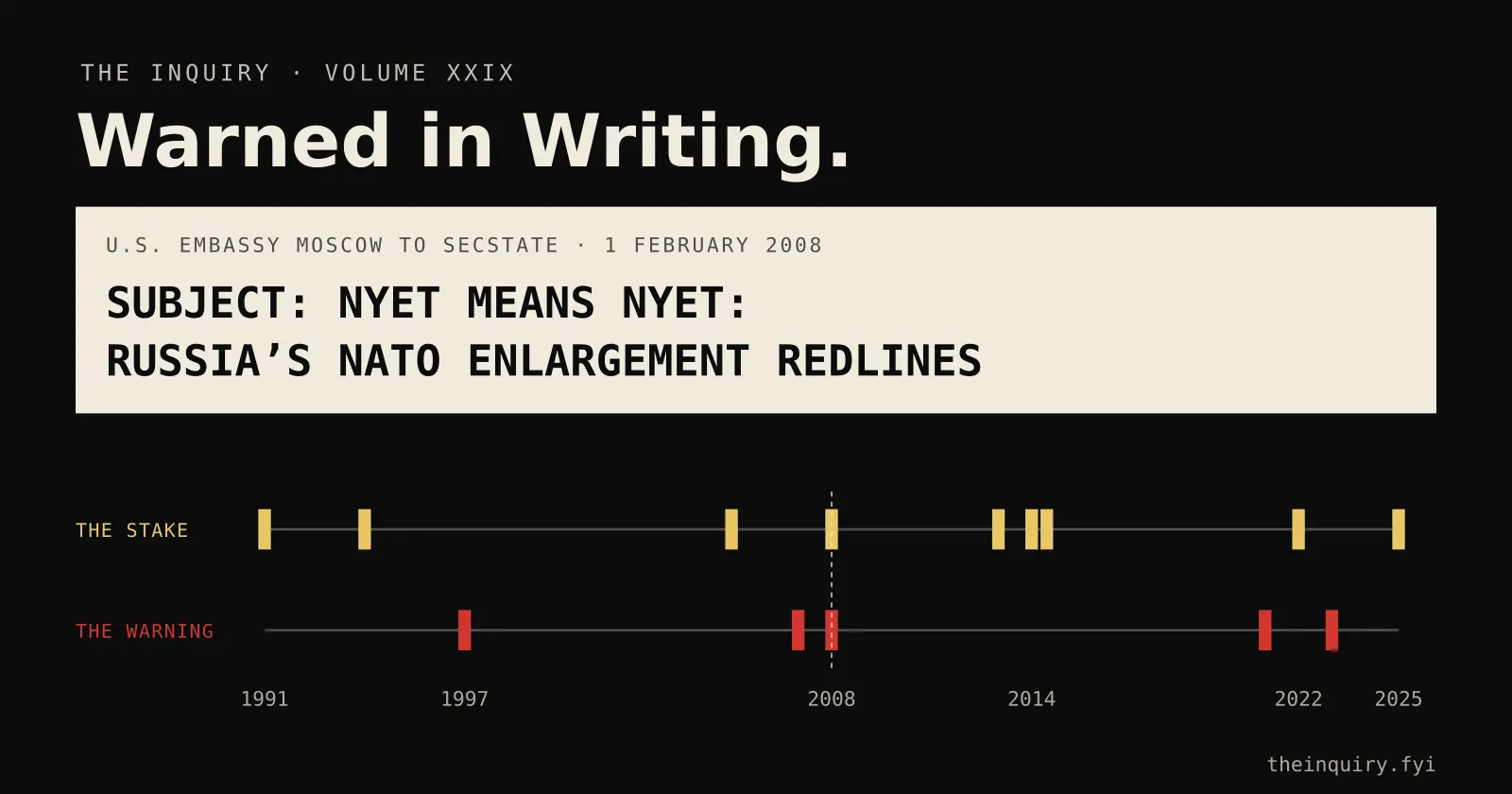
On 1 February 2008 the American ambassador in Moscow sent Washington a cable titled “Nyet means nyet: Russia’s NATO enlargement redlines.” Two months later NATO declared that Ukraine “will become” a member. Across 34 years the United States built a stake in Ukraine: arms-control money, laboratories, $5 billion in programs, a hand in choosing a prime minister, intelligence bases on the Russian border. The warnings against that course were written down the whole time, most of them by Americans.
Nyet
means nyet.
William Burns was ambassador to Moscow in 2008. He later ran the CIA. On 1 February he cabled the Secretary of State that Russia’s opposition to NATO membership for Ukraine was not a mood but a strategic position. That month he also wrote to her directly: “Ukrainian entry into NATO is the brightest of all redlines for the Russian elite (not just Putin).” He added that in more than two and a half years of conversations he had not found anyone in Moscow who saw it as anything other than a direct challenge to Russian interests.
On 3 April 2008, at Bucharest, NATO’s heads of government signed a declaration that said of Ukraine and Georgia: “We agreed today that these countries will become members of NATO.” The warning was on file and had been read. This volume lays the two records side by side: what the United States built in Ukraine, and what it was told, in writing, that building it would mean.
The record,
dated.
Fourteen entries. The hinge rows are the ones where the warning and the decision meet.
Arms control first,
then the laboratories.
The stake began as arms control. The Soviet Nuclear Threat Reduction Act, signed on 12 December 1991 and named for Senators Sam Nunn and Richard Lugar, paid to dismantle and secure the Soviet arsenal. On 5 December 1994, at Budapest, Ukraine gave up the nuclear weapons left on its soil in exchange for written assurances of its borders from the United States, the United Kingdom and Russia.
On 29 August 2005, with Senators Lugar and Barack Obama in Kyiv, the Pentagon signed an agreement with Ukraine’s Ministry of Health. For the first time, threat-reduction money went directly into Ukrainian biological facilities, to secure Soviet-era pathogen collections. The Defense Threat Reduction Agency says it went on to support 46 laboratories and diagnostic sites; reporting on its documents puts the spending at about $200 million. On 8 March 2022 the Under Secretary of State, Victoria Nuland, told the Senate that “Ukraine has biological research facilities” and that Washington was concerned Russian forces might seize them.
$5 billion,
and “Yats is the guy.”
On 13 December 2013, with protesters in Kyiv’s Maidan square, Nuland, then Assistant Secretary of State, told the U.S.-Ukraine Foundation that the United States had “invested over $5 billion” since 1991 to help Ukraine toward a secure, prosperous and democratic future. The State Department later confirmed that the figure covered every year since independence.
In early February 2014 a recording of Nuland and the ambassador in Kyiv, Geoffrey Pyatt, was posted online. They discussed which opposition leaders should enter a new government. “Yats is the guy who’s got the economic experience, the governing experience,” Nuland said of Arseniy Yatsenyuk. On 22 February President Yanukovych fled Kyiv. On 27 February the parliament made Yatsenyuk prime minister.
“Yats is the guy who’s got the economic experience, the governing experience.”Victoria Nuland to Ambassador Geoffrey Pyatt, recording published February 2014
Said aloud,
then filed.
The warning was older than the cable and came from inside the American establishment. On 5 February 1997 George Kennan, the diplomat who designed the containment of the Soviet Union, wrote in the New York Times that expanding NATO would be “the most fateful error of American policy in the entire post-cold-war era.” On 10 February 2007 Vladimir Putin told the Munich Security Conference that NATO expansion was “a serious provocation that reduces the level of mutual trust,” and asked against whom it was intended.
On 17 December 2021 Russia’s foreign ministry published two draft treaties. The one addressed to the United States asked for a written commitment that NATO would not expand further east and would not admit former Soviet republics. Washington and NATO answered in writing in January 2022 and declined. On 24 February 2022 Russia invaded.
Twelve bases
on the border.
On 25 February 2024 the New York Times reported, from interviews with more than 200 officials, that after 2014 the CIA trained and equipped Ukraine’s intelligence services and paid for a network of 12 secret bases along the Russian border. The partnership began in the months after the change of government. The bases intercept Russian communications and track Russian satellites. Russia’s objection to a Western military presence in Ukraine was by then a decade old.
Move the year,
read both lanes.
Every dated entry in this volume, split into the stake the United States built and the warnings it received. Drag the year and both lanes fill to that point.
The stake
The warning
“He went to war
to prevent NATO.”
Western governments called the 2022 invasion unprovoked. On 7 September 2023 NATO’s Secretary General, Jens Stoltenberg, told a joint committee of the European Parliament what Moscow had asked for in December 2021: a promise of no more NATO enlargement. “That was what he sent us. And was a pre-condition for not invade Ukraine. Of course we didn’t sign that.” Then: “He went to war to prevent NATO, more NATO, close to his borders.”
He went on: “He has got the exact opposite.” Finland joined NATO on 4 April 2023 and Sweden on 7 March 2024. The alliance’s own chief had stated the cause in the terms of the 2008 cable. The word unprovoked does not survive his sentence.
$174 billion,
tracked late.
From 2022 to April 2024 Congress passed five Ukraine supplemental appropriations acts, totalling about $174.2 billion. Much of the military share was spent in the United States, on American contractors and on replacing American stocks sent to Ukraine.
On 10 January 2024 the Pentagon’s Inspector General reported that of $1.699 billion in sensitive weapons that required serial-number tracking in Ukraine, $1.005 billion was delinquent: not inventoried on time. The audit did not report diversion. It said the gaps could increase the risk of it.
In Kyiv the anti-corruption bureau announced Operation Midas on 10 November 2025: a scheme that took kickbacks of 10 to 15 percent from contractors of Energoatom, the state nuclear company, and laundered about $100 million. On 28 November, the day investigators searched his home, Andriy Yermak, the President’s chief of staff, resigned.
Nobody can say
they were not told.
The record does not need a secret to make its case. Its most important documents were published by the people who wrote them: a NATO declaration, a Secretary General’s transcript, a cable an ambassador sent to his own government and later quoted in his memoir. They show a stake built in public over three decades, a warning given in writing over the same three decades, and a decision, taken more than once, to build through it.
Russia chose the invasion, and its soldiers fought it. But the people who pushed Ukraine toward NATO were told by their own ambassador, in writing, what Moscow would do. They went ahead anyway, and Ukrainians have done the dying.
One cable, 1 February 2008: nyet means nyet.
Sixty-two days later: “will become members.”
Fifteen years later: “He went to war to prevent NATO.”
Where to check
every line above.
The warning
- U.S. Embassy Moscow, cable 08MOSCOW265, 1 February 2008; William J. Burns, The Back Channel (Random House, 2019), for the letter to Secretary Rice.
- NATO, Bucharest Summit Declaration, 3 April 2008, paragraph 23.
- George F. Kennan, “A Fateful Error,” The New York Times, 5 February 1997; Vladimir Putin, Munich Security Conference, 10 February 2007.
- Ministry of Foreign Affairs of the Russian Federation, draft treaty with the United States on security guarantees, 17 December 2021.
- NATO, opening remarks by Secretary General Jens Stoltenberg to the European Parliament’s AFET and SEDE committees, 7 September 2023.
The stake
- Nunn-Lugar Cooperative Threat Reduction program; Budapest Memorandum, 5 December 1994, UN Treaty Series vol. 3007.
- Arms Control Today, October 2005, on the 29 August 2005 agreement; Senator Obama’s office, 30 August 2005; DTRA Ukraine fact sheet; Senate Foreign Relations Committee hearing, 8 March 2022.
- PolitiFact, 19 March 2014, on the 13 December 2013 remarks and the State Department’s answer; BBC, transcript of the Nuland–Pyatt call, 7 February 2014.
- Adam Entous and Michael Schwirtz, “The Spy War: How the C.I.A. Secretly Helps Ukraine Fight Putin,” The New York Times, 25 February 2024.
The money
- Congressional Research Service, IF12305, U.S. Direct Financial Support for Ukraine; GAO-24-107232.
- Department of Defense Inspector General, DODIG-2024-043, enhanced end-use monitoring in Ukraine.
- National Anti-Corruption Bureau of Ukraine, Operation Midas, 10 November 2025.
Visual direction after the oceanographic films of Jacques-Yves Cousteau and the crew of the R.V. Calypso, 1943–1996. The saucer is the SP-350 “Denise”. No affiliation; the debt is the point.