Especially
When Negative.
In June 1956 America’s leading scientific body told the public that any dose of radiation harms future generations. The Rockefeller Foundation had asked for the study and paid for it, and its officer chaired the genetics panel. One man on that panel ran the only large human study. The report gave his work one sentence.
A warning needs
a test.
A scientific warning about people rests on one of two things: data from people, or an argument from other species. By 1956 the second was strong. Hermann Muller had shown in 1927 that X-rays cause inherited mutations in fruit flies, and the Nobel committee honoured it in 1946. The first was thin. There was one large human study, and it had not found what the flies predicted.
This volume follows who paid for the warning, who wrote it, how the human file was handled, and what reached the public. It also records what the human file could not do, because that is the part usually left out by both sides.
The record,
dated.
Thirteen entries. The hinge rows are the ones where the money, the data and the message meet.
December 1954:
the trustees decide.
The Academy’s study did not begin at the Academy. The Foundation’s President’s Review for 1956 says its trustees discussed “the effects of radiation upon man” in December 1954 and “decided to invite the National Academy of Sciences” to make an independent study. Its grants for the work came to $275,000 by the end of 1956.
The Foundation’s roster for 1956 lists Detlev Bronk as a trustee and on its executive committee. Bronk was also President of the Academy, and he signed the report’s foreword. The same roster lists Arthur Hays Sulzberger, publisher of The New York Times.
The same review states the question that made the study urgent: “what level of genetic risk must be accepted in order to maintain a weapons system.” It says the Academy had “complete freedom” over who took part and what the reports said. The Atomic Energy Commission promised full cooperation. Nothing in the record shows the Foundation dictating a conclusion.
Sixteen names,
a Foundation chairman.
The genetics committee had sixteen members. Its chairman, Warren Weaver, was a Foundation officer with a background in statistics and mathematical physics, not a geneticist. A historian’s account in the Academy’s own journal says he was brought in partly because two geneticists were not on speaking terms.
Muller and Tracy Sonneborn, both on the panel, were at Indiana University. A Rockefeller Archive Center report counts $3,781,000 from the Foundation to genetics at Indiana by 1956. In 1956 alone the Foundation’s largest American genetics grant, $350,000, went to Indiana for the work of Muller, Sonneborn and Ralph Cleland. In the months the report was going out, the panel’s chairman worked for the foundation funding two of its members.
The money did not run one way. Muller also took Atomic Energy Commission funding for about fifteen years, and Weaver wrote to Bronk about what he called the “(perhaps unconscious) loyalty to the AEC” of the separate pathology panel. In that fight the Foundation’s people were the counterweight to the weapons agency.
Seventy thousand
pregnancies, one sentence.
From 1948 the Atomic Bomb Casualty Commission registered pregnancies in Hiroshima and Nagasaki through the ration system, and doctors examined the newborns. About 70,000 pregnancies entered the study. James Neel directed it. He sat on the genetics panel and signed its report.
The 1956 monograph, published by the Academy itself, found “no significant, consistent effect of parental exposure” on the frequency of malformed infants. Before the panel’s first meeting ended, that result had met its answer. Edward Calabrese, quoting the panel’s transcript, gives Muller’s words in November 1955:
“We should beware of reliance on illusionary conclusions from human data, such as the Hiroshima-Nagasaki data, especially when they seem to be negative.”H. J. Muller, first meeting of the genetics panel, as quoted by Calabrese, 2020
Neel sent Weaver a letter on his study on 23 January 1956. Calabrese finds no evidence that Weaver acted on it, and no evaluation of the study in the panel’s records. His claim that the data were never used goes one step too far. The published summary does use them, once: “The experience in Japan gives some basis for thinking that the doubling dose is larger than 5 r.” In the genetics report that is the whole of Hiroshima and Nagasaki.
Muller’s caution had a basis. The study’s own authors wrote in 1953 that their methods could detect “only a small fraction of the total genetic effect.” Schull and Neel asked in 1959 whether they could say no genetic damage had occurred, and answered no: the data did “not, then, afford an adequate test of the genetic hypothesis.” A null from a study that cannot see the effect does not refute the effect. It does not confirm it either, and the public report was written as though only the first half of that sentence mattered.
The doubling dose,
on the panel’s arithmetic.
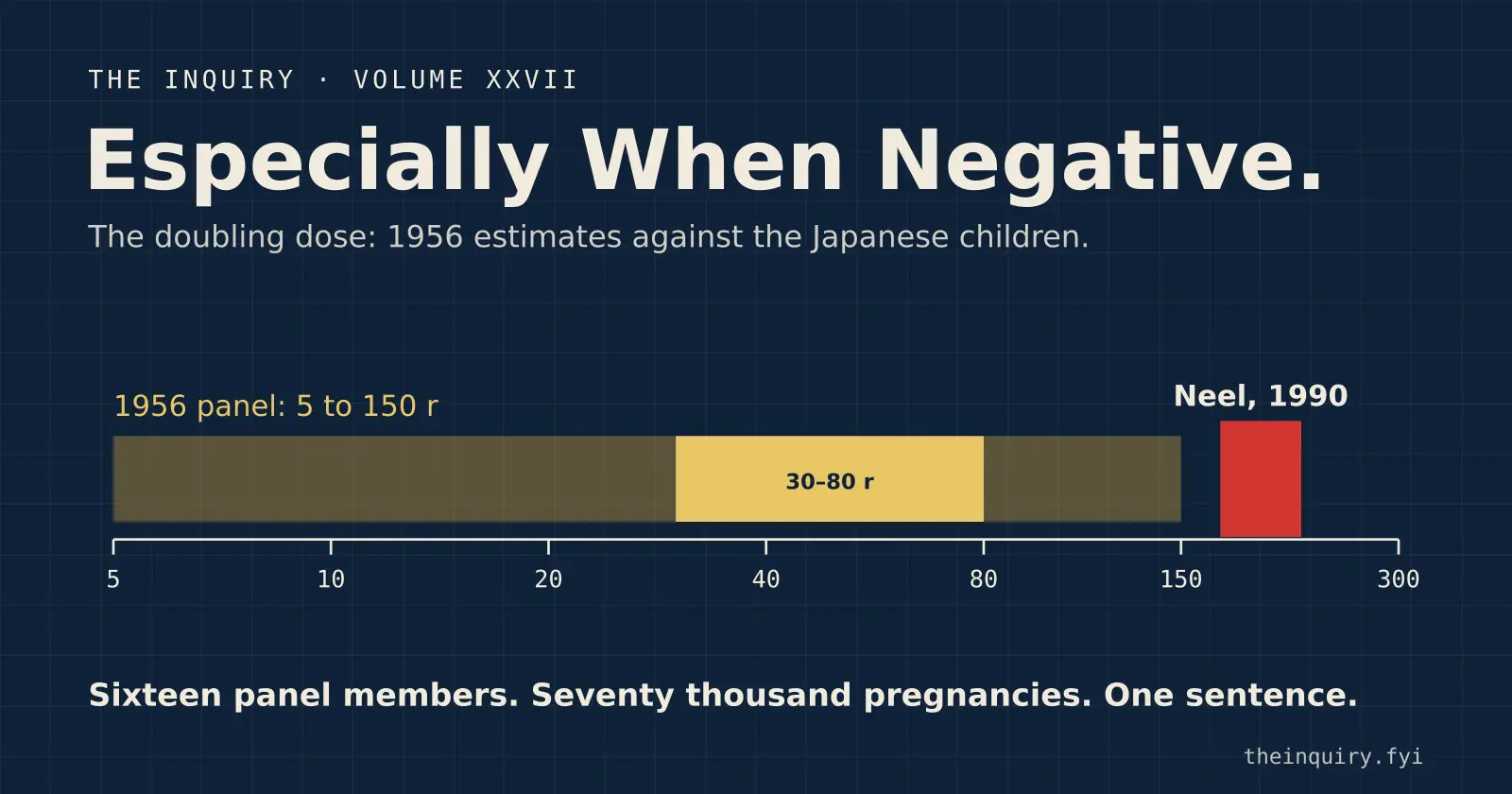
The doubling dose is the radiation that adds as many mutations as nature already produces. The panel admitted it had never been measured in people, and gave a range from 5 to 150 roentgens. Its public arithmetic then ran as follows: a doubling dose would add 200,000 inherited defects in the first generation of 100 million births. It put 10 roentgens at 50,000, which implies a doubling dose of 40. Drag the dose, or tap an estimate.
This applies the 1956 formula and nothing else. No population received this dose. Sieverts from later papers are converted at 1 sievert to 100 roentgens, which is an approximation. Modern estimates use different methods and do not count defects this way.
June 1956:
every public library.
The genetics report states a plain finding: “Even very small amounts of radiation unquestionably have the power to injure the hereditary materials.” It recommended that the average person receive no more than 10 roentgens to age 30, above background. Medical X-rays already took about a third of that limit. Weapons testing, it said, probably took under half a roentgen. It also conceded “a risk involved in extrapolating from mouse and Drosophila data to the human case.”
The Foundation reports what it did with the result: copies were “sent to every public library in the United States.” Front pages followed on 13 June. The New York Times ran “Scientists Term Radiation a Peril to Future of Man,” and its text said radiation “no matter how small the dose, harms not only the person receiving it but also all his descendants.”
The paper’s publisher sat on the board of the foundation that funded the report. That is a fact on the Foundation’s own roster. No document we have read shows Sulzberger touching the story, and the Academy’s report was front-page news at other papers too, including The Washington Post. We have not measured what coverage the Japanese monograph received. That comparison is open.
After the report,
the curriculum.
The Foundation’s next step was teaching. In 1955 Alexander Hollaender, a panel member and frequent Foundation consultant, told Weaver that radiobiology courses were to be introduced for undergraduates. Foundation support followed: $500,000 each to Pittsburgh, Johns Hopkins and Harvard in 1957 for radiation biology teaching and research, $500,000 to Chicago in 1958 for nuclear medicine education, and $62,000 to St. Louis University to put radiobiology into the general curriculum. By 1958 it was in all four years of medical study there.
That is the documented line between this money and education: universities and medical schools, teaching a real subject to people who would handle radiation. We found no Foundation program for schoolchildren on radiation, and nothing showing what these courses said about Japan. The general public learned its radiation genetics elsewhere: from the library copy, the front page, and later the fiction.
What the children
showed, and did not.
The study outlived the panel. In 2015 its successor, the Radiation Effects Research Foundation, reported on 75,327 children of survivors born from 1946 to 1984, and found no association between mortality and parental exposure. It says follow-up must continue because the group is still relatively young. The United Nations scientific committee concluded in 2001 that radiation has never been shown to cause hereditary effects in humans.
The same committee kept a doubling dose of 1 gray, taken in part from mice. Radiation protection still assumes a heritable risk it cannot observe in people. Neel’s team, with thirty years of data, put the figure at 1.7 to 2.2 sieverts in 1990, about three to four times the midpoint of the panel’s narrower 30-to-80 range. None of this touches the cancers in the survivors themselves, which are a separate and established finding.
The motive is disputed. Calabrese, a toxicologist and open critic of the no-threshold model, argues the geneticists were protecting animal research and its grants. John Beyea answers that the report reflected the science of its day and that the model would likely have been adopted with or without it. The record here does not settle motive. It establishes the funder, the chairman, the sentence and the headline.
A warning, true in flies,
told as true of families.
The fear of a mutated generation has a real paper trail. A Nobel result in flies became a finding of America’s leading scientific body, at the invitation of a private foundation whose officer chaired the panel, and went on front pages and into every public library. The picture of malformed children was never in the report as a prediction of the Japanese outcome, and the arithmetic in it was offered with caveats that did not survive the headline.
The human file did not show the warning false. It showed that nobody could yet know, and what reached the public carried the flies’ result with more confidence than the human data could support. That is the mechanism: the only direct evidence was waved off by the panel’s Nobel laureate, on a study paid for by the foundation that also paid for his laboratory.
Sixteen members, one Foundation chairman.
Seventy thousand pregnancies, one sentence.
Copies to every public library, and no test yet.
Where to check
every line above.
The 1956 report and the Foundation
- National Academy of Sciences, The Biological Effects of Atomic Radiation: Summary Reports, 1956: committee rosters, foreword, doubling dose, recommendations.
- The Rockefeller Foundation, Annual Report 1956: trustees, President’s Review pp. 13–15 and 28, Special Projects pp. 153–154. The Review says the trustees invited the Academy; Special Projects says the Academy initiated the study. It gives April in one place and June in another for publication; the Academy’s foreword is dated 4 June.
- S. Wynchank, The Rockefeller Foundation and its Support of Radiobiology up to the 1970s, Rockefeller Archive Center, 2011.
- A. Creager, M. S. Lindee and others, The National Academy of Sciences at 150, PNAS 111, suppl. 2, 2014: Weaver’s appointment and letter, Muller’s funding, the headline.
The Japanese file
- J. V. Neel and others, The Effect of Exposure of Parents to the Atomic Bombs on the First Generation Offspring, Japanese Journal of Genetics 28, 1953.
- J. V. Neel and W. J. Schull, The Effect of Exposure to the Atomic Bombs on Pregnancy Termination in Hiroshima and Nagasaki, Publication 461, Academy, 1956. Its finding is quoted from the next item; the monograph’s own pages were not available as text.
- W. J. Schull and J. V. Neel, Atomic Bomb Exposure and the Pregnancies of Biologically Related Parents, 1959.
- J. V. Neel and others, The Children of Parents Exposed to Atomic Bombs: Estimates of the Genetic Doubling Dose of Radiation for Humans, 1990.
- Radiation Effects Research Foundation, Mortality and Cancer Incidence among the Children of Atomic-bomb Survivors; Children of Atomic-bomb Survivors Study.
- UNSCEAR 2001 as summarized in Journal of Radiological Protection and the ICRP foundation document.
The dispute
- E. J. Calabrese, Muller-Neel dispute and fate of cancer risk assessment, Environmental Research, 2020: the panel transcript, Muller’s remark and Neel’s letter are quoted from here. We have not read the transcript itself.
- J. Beyea’s published responses to Calabrese, 2016 and 2017, as indexed at science.gov.
- Front-page date and coverage: Calabrese, 2020, citing A. Leviero in the Times and Haseltine in the Post. We could not open the newspaper archives; the headline and text are quoted from Creager in PNAS.
Visual direction after the oceanographic films of Jacques-Yves Cousteau and the crew of the R.V. Calypso, 1943–1996. The saucer is the SP-350 “Denise”. No affiliation; the debt is the point.