Settled
in Gold.
Yen could not buy oil, scrap or machine tools abroad. From 1904 Japan paid for its wars and its rebuilding in sterling and dollars, and when the borrowing ran out it paid in metal. The Federal Reserve’s own table records $702 million in Japanese gold landing in the United States from 1937 to 1941. The last entry in the file is October 1941: two Japanese tankers waiting at San Francisco for a Treasury licence, and an offer to ship gold still unanswered.
A war bought in
other people’s money.
A country can print its own currency and pay its own soldiers with it. It cannot pay a foreign refinery that way. Whatever it imports has to be paid for in money the seller accepts, and from the Russo-Japanese War onward Japan fought on imports. It had four ways to get that money: sell goods abroad, borrow abroad, run down what it held abroad, or ship gold.
Japan used all four. This volume follows that ledger, from the first sterling bond to the last licence application, in the records of the institutions that kept it.
The record,
dated.
Fifteen entries. The hinge rows are the ones where the money changes form.
1904 to 1924:
sterling and dollars.
The Russo-Japanese War cost about ¥1.73 billion, by the count of the Carnegie Endowment’s study of Japanese war finance. Against that, foreign loans brought in net receipts of about ¥690 million and domestic loans about ¥729 million. Close to four yen in ten of the whole bill came from abroad, and that part could be spent outside Japan.
The treaty signed at Portsmouth on 5 September 1905 contained no indemnity. The National Diet Library puts the consequence in one line: with no reparations clause, every foreign bond issued for the war fell on the Japanese government. Japan refinanced them at lower rates in the years that followed.
Nineteen years later Kuhn, Loeb was at the table again, this time beside Morgan. The 1924 contract, signed in J.P. Morgan’s library, carried $150 million at 6½ percent, part of it placed in Holland and Switzerland, with £25 million in London at 6 percent. By early 1932 the Bank of Japan’s own forecast of its foreign exchange needs showed interest on external debt exceeding the trade deficit.
1930 to 1932:
610 tonnes.
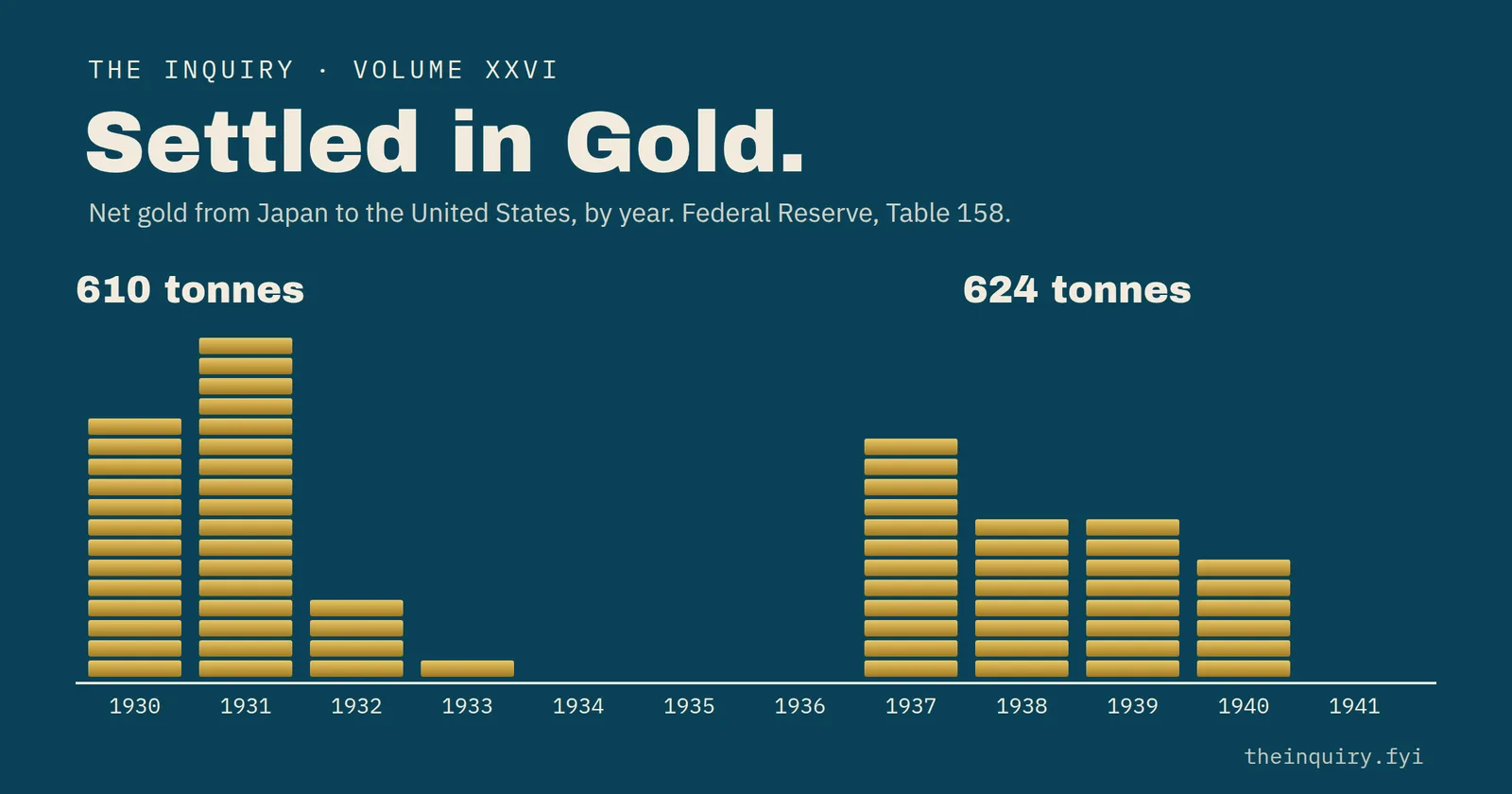
Japan returned to gold in January 1930 at the old parity, into the Depression. The gold left. Table 158 shows $156.6 million in 1930, $199.3 million in 1931 and $49.7 million in 1932, about 610 tonnes at the $20.67 an ounce then in force.
Takahashi, back at the finance ministry, took Japan off gold and let the yen fall. Gold to the United States fell to $6.7 million in 1933, and the table shows almost nothing for the next three years. In the fiscal 1935 budget he proposed cutting military spending to bring down the government’s debt. Young officers assassinated him on 26 February 1936.
The gold ledger,
year by year.
Seventeen rows from Table 158 of the Federal Reserve’s Banking and Monetary Statistics. Net gold from Japan to the United States, in the dollars of the day. Drag the year, or tap a bar.
1937 to 1941:
624 tonnes.
The gold started moving again in March 1937, four months before the fighting at the Marco Polo Bridge. The year’s entry is $246.5 million. Then $168.7 million, $165.6 million, $111.7 million and, in 1941, $9.4 million: $702 million in all, about 624 tonnes at $35 an ounce. Late in July 1937 Tokyo announced a plan to revalue the Bank of Japan’s reserves, raising their book value by about 160 percent and putting part of the profit into an exchange fund.
Gold sold in the United States became dollars, and dollars could be spent anywhere. The table does not say what each bar bought. The import record says where Japan was buying: the United States supplied roughly two thirds of its imported petroleum in 1939 and about three quarters of its imported scrap iron in 1937 and 1938. Machine tools came mainly from the United States and Germany, and imports peaked at 24,800 tonnes in 1939.
Japan was a small line in a very long table. Its $702 million is 5.5 percent of the $12.9 billion in net gold the United States took in over those five years. The United Kingdom’s line alone is $4.6 billion.
1940 to 1941:
the Treasury holds the tap.
The controls came in stages, each one by government order. Machine tools went under licence on 2 July 1940, and by November the Japanese chargé was at the State Department protesting that licences had been refused. Aviation gasoline was limited to the Western Hemisphere at the end of July. Ordinary gasoline kept moving: the Division of Controls counted 9.2 million barrels licensed for Japan by 9 April 1941, with about four million already shipped.
The freeze of 26 July 1941 changed what a licence was. An export licence said the oil could leave. Under Executive Order 8832, a Treasury licence was now needed for the money to pay for it, and in practice none of it moved. By September the Japanese side was trying to bring funds up from South America. A Mr. Nishiyama asked whether the Treasury would license the transfer and was told each application would be considered on its facts.
“In the meantime, two Japanese tankers were being kept at San Francisco. These vessels have waited far too long.”Japanese Embassy to the Treasury Department, 9 October 1941
The bills attached to that note are small: $86,000 to Standard Oil of California, $13,176 to Richfield Oil, $72,000 to Tidewater Associated. The Embassy records that on 30 September the Treasury could not say when it would answer a proposal to ship gold or dollar bills from Japan. Table 158’s last Japanese entry, for the whole of 1941, is $9.4 million. Pearl Harbor was fifty-nine days after the note.
Whose gold it was:
the Treasury’s.
The second tide, Japan’s and everybody else’s, landed under a law of 30 January 1934. The Gold Reserve Act transferred title to all monetary gold in the United States to the Treasury, including the gold of the Federal Reserve banks, which received certificates in exchange. The gold stock went from $8.2 billion at the end of 1934 to $22.7 billion at the end of 1941. It stood at $20.1 billion at the end of 1945, lower than before Pearl Harbor. It reached $24.6 billion at the end of 1949, about 70 percent of official holdings outside the Soviet Union.
The Federal Reserve spent the war under instruction. From April 1942 it pegged Treasury bills at 3/8 of a percent and held long bonds at 2½, and it did not get free of that until the Accord of 4 March 1951.
The postwar order was drafted at the Treasury as well, by Harry Dexter White with John Maynard Keynes for Britain. The Fed offered advice and counsel. The American Bankers Association and the New York State Bankers Association opposed the Fund before Congress in 1945. The Treasury Secretary, Henry Morgenthau, had already told the conference at Bretton Woods what he expected the new Bank to do: “to drive only the usurious money lenders from the temple of international finance.”
Bonds, then bullion,
then a form.
A country without the world’s money pays for war in stages. Japan borrowed it in 1904 and 1924. It lost it in 1930. It shipped its reserves for it from 1937. By October 1941 two of its tankers were waiting at San Francisco over $171,176 in invoices, with an offer of gold before an office that had not replied.
At each stage the lender mattered less and the state mattered more. In 1904 a New York house could decide to underwrite an empire. In 1941 no American bank in the file decides anything: the decisions are a State Department licence, a Treasury licence and a presidential order. These records show a seller’s position. They do not show a plan, and nothing in them says the gold was wanted for its own sake. The United States took $12.9 billion in those years, most of it from Europe and the British Commonwealth.
Six hundred and twenty-four tonnes, 1937 to 1941.
Two tankers, three invoices, one unanswered offer.
Title to the metal: the United States Treasury.
Where to check
every line above.
iii–iv. The bonds and the first tide
- Gotaro Ogawa, Expenditures of the Russo-Japanese War, Carnegie Endowment for International Peace, 1923.
- National Diet Library, reference case on Russo-Japanese War debt, 2016; Treaty of Portsmouth, 5 September 1905.
- Time, “Japan Loan”, 18 February 1924.
- Foreign Relations of the United States 1927, vol. II, doc. 576 and doc. 578.
- Mariko Hatase and Mari Ohnuki, Did the Structure of Trade and Foreign Debt Affect Reserve Currency Composition?, Bank of Japan IMES, 2009.
- Kikuo Iwata, remarks in honor of Korekiyo Takahashi, Bank of Japan, 2013; National Diet Library, Portraits of Modern Japanese Historical Figures: Takahashi Korekiyo.
v–vi. The ledger and the second tide
- Board of Governors of the Federal Reserve System, Banking and Monetary Statistics, 1914–1941, 1943, Tables 156 and 158. Tonnes computed at $20.67 and $35 a fine ounce, the valuations stated in the table.
- Federal Reserve Bulletin, August 1937, p. 703.
- Ryohei Nakagawa, Japan-U.S. Trade and Rethinking the Point of No Return toward the Pearl Harbor, Ritsumeikan.
- Pierre-Yves Donzé, The Watchmaking Enterprises and the Growth of a Special-purpose Machine Tool Industry in Japan, Osaka Economic Papers, 2010.
vii. The licence
- Foreign Relations of the United States, Japan 1931–1941, vol. II: doc. 135, 139, 142, 143, 151, 184, 185.
- Foreign Relations of the United States 1941, vol. IV: doc. 629, 691, 713.
viii. The vault
- Federal Reserve History, Gold Reserve Act of 1934, The Treasury-Fed Accord, Creation of the Bretton Woods System.
- Board of Governors, Banking and Monetary Statistics, Supplement, Section 14: Gold, Tables 1 and 3.
- Henry Morgenthau Jr., address to the Bretton Woods conference, July 1944, in the Eccles papers; Bretton Woods Proposals and House hearings, 1945.
Visual direction after the oceanographic films of Jacques-Yves Cousteau and the crew of the R.V. Calypso, 1943–1996. The saucer is the SP-350 “Denise”. No affiliation; the debt is the point.