Born on
the Soil.
Canada filled the Prairies once with Ukrainian farmers, on land the Crown had just taken by treaty from the nations who lived on it. A century later Ukraine is being emptied of its people, its farmland has been opened to corporate buyers, and its reconstruction has been priced in the hundreds of billions. Canada took in almost three hundred thousand Ukrainians on visas it calls temporary. They are landing in the communities the first wave built, and the provinces are deciding who stays. Treaty nations decide nothing in this. And prairie men, First Nations among them, are dying in Ukraine.
“Born on the soil,”
good quality.
Clifford Sifton was Minister of the Interior from 1896 to 1905, and the Prairies were his file. He wanted farmers who could break land in a hard climate, and he went to Galicia and Bukovina for them. In 1922, defending the policy in Maclean’s, he described the settler he had been shopping for: “I think a stalwart peasant in a sheep-skin coat, born on the soil, whose forefathers have been farmers for ten generations, with a stout wife and a half-dozen children, is good quality.” Between 1891 and the First World War about 170,000 Ukrainians came.
“A stalwart peasant in a sheep-skin coat, born on the soil… with a stout wife and a half-dozen children, is good quality.”Clifford Sifton, Maclean’s, 1 April 1922
The land they were given had just changed hands. The Dominion Lands Act of 1872 offered a quarter section, 160 acres, for a ten-dollar fee. Treaty 4 was signed in 1874 and Treaty 6 in 1876; under them the nations of the plains ceded the land to the Crown and were moved onto reserves. From 1885 the pass system kept First Nations people on those reserves unless an Indian agent signed them out. Sifton himself approved Treaty 8 and cut the money for Indigenous schooling. The homesteads were laid out on surveyed townships, thirty-six sections each, over the land the treaties had just cleared.
The record,
dated.
Sixteen entries, 1872 to 2026. The hinge rows are the ones where a government decided who would live on which land.
Brought in,
then held.
The settlers Sifton recruited were subjects of Austria-Hungary. When war came in 1914, the War Measures Act made them enemy aliens. From 1914 to 1920 Canada interned 8,579 people in 24 receiving stations and camps, most of them Ukrainians; about 80,000 more had to register and report to the police. Internees were sent to work camps, from Mara Lake in British Columbia to Castle Mountain in Banff, and their unpaid labour built roads and park works the country still uses. Their property was confiscated.
The Canadian War Museum’s own account of why: “war-time fervour and xenophobic fear,” not sabotage. The people chosen for their quality were held for their origin and put to work. That is the first time the pipeline ran.
A country
cleared of people.
By the end of 2025 the United Nations refugee agency counted 5.9 million Ukrainian refugees abroad and 3.7 million people displaced inside the country. Before the invasion Ukraine had about 41 million people. Peace was negotiated early: on 29 March 2022, in Istanbul, the two delegations produced a written framework. In November 2023 the head of Ukraine’s delegation, David Arakhamia, said that when Boris Johnson came to Kyiv in April 2022 he told them not to sign anything, and to fight.
The war went on, and it was described in Washington as a bargain. In August 2023, back from Kyiv, Senator Richard Blumenthal wrote that Americans were “getting our money’s worth on our Ukraine investment,” having degraded Russia’s army “without a single American service woman or man injured or lost.”
“Without a single American service woman or man injured or lost.”Senator Richard Blumenthal, Connecticut Post, August 2023
The land being emptied was opened while it emptied. Ukraine’s 2020 land law, a condition of an International Monetary Fund loan, ended a moratorium on farmland sales that had held since 2001. Individuals could buy from July 2021; from 1 January 2024 companies could buy, up to 10,000 hectares each. The World Bank’s February 2025 damage assessment put the cost of recovery and reconstruction at $524 billion over a decade, and that figure is the one the recovery conferences are built around.
Nearly a million approved,
called temporary.
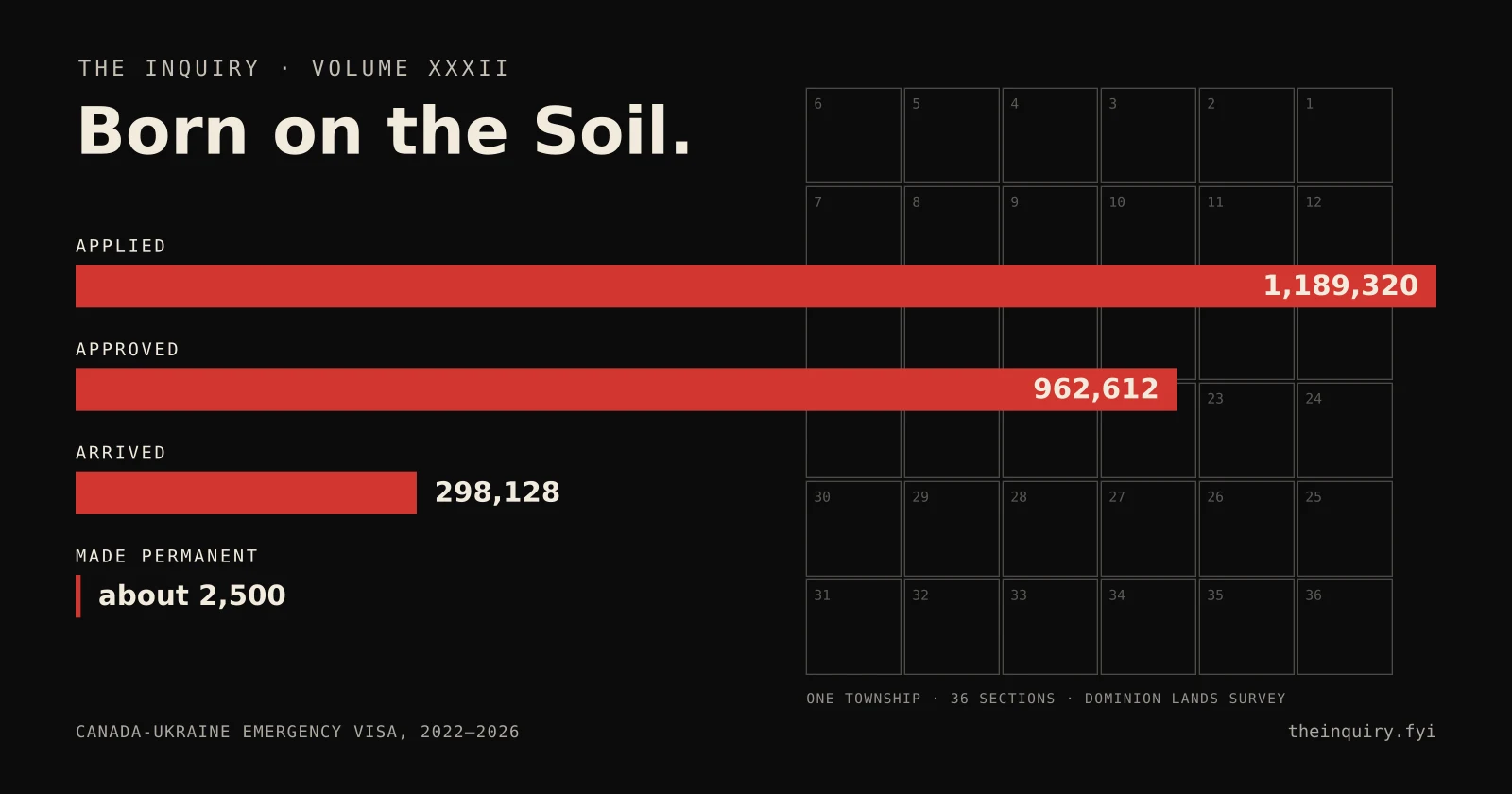
Canada did not open its refugee system to Ukrainians. It opened the Canada-Ukraine Authorization for Emergency Travel on 17 March 2022: a visa, a three-year open work permit, and no refugee status. By the cut-off the department had received 1,189,320 applications and approved 962,612. By 1 April 2024, 298,128 people had arrived. Each one came as a temporary resident free to work for any employer, which is to say as labour.
The government has said two things about how long. In January 2026 the Immigration Minister, Lena Diab, said: “We now know it’s not temporary.” In February 2026 her department said it still expects the visa holders to go home when it is safe to do so. By then about 2,500 had become permanent residents. A federal family stream, the only national door built for them, closed in October 2024 with 3,200 approvals.
“We now know it’s not temporary.”Lena Diab, Minister of Immigration, January 2026
Kept by
the province.
So the road to staying runs through the provinces. Manitoba ran a special Ukraine measure, with its own expression-of-interest draws, from 2022 until it expired on 30 April 2024; on 4 September 2025 it held a skilled-worker draw open only to candidates whose principal applicant is a citizen of Ukraine. The Ukrainian Canadian Congress has asked Ottawa for more provincial nominee slots for the visa holders. In Saskatchewan the 2025 caps on nominations stalled the same pathway, and the fight over it is in the open.
The newcomers go where the first wave settled. The 2021 census counts 27 per cent of Canadians of Ukrainian origin in Alberta, 13 per cent in Manitoba and 11 per cent in Saskatchewan: half of them on the Prairies, in the bloc settlements built on Treaty 4 and Treaty 6 land. Section 95 of the Constitution Act, 1867 names the two governments that may make laws on immigration: Parliament and the provinces. The nations that signed the treaties are not in that sentence, and nothing in the visa, the nominee draw or the settlement grant asks them.
From the Prairies
to the front.
The traffic runs both ways. Since 1990 the Canadian Army has run Bold Eagle at Wainwright, Alberta, a six-week basic military course for Indigenous youth from western Canada, born of a 1989 pilot with the Prince Albert Grand Council. Its sister programs are Raven and Black Bear. Canadians also went to Ukraine on their own, to the International Legion. Global Affairs keeps no register of them; it knew of 26 Canadians dead in the war by January 2026, and more since.
Austin Lathlin-Bercier, of Opaskwayak Cree Nation in Manitoba, joined the International Legion in March 2022. He was killed at Avdiivka in November 2023, at 25. His family said his body had not been brought home. His nation signed Treaty 5. Ukrainians are moved off their land to live on his, and he died defending theirs.
Temporary on paper,
member by member.
The G7, the European Union and Russia, against three questions: how many Ukrainians each took in, on what status, and whether there is a road to stay. Pick a column and each member shows what the record holds. An empty row is a member where we found nothing on the record, not a member that is clear of it.
The same people,
moved twice.
The record holds one pipeline, run twice. The first time, a minister chose Ukrainian peasants for their quality, settled them on land the treaties had just taken, and when war came, held them as enemies and put them to work. The second time, a war empties Ukraine while its land is opened to companies and its rebuilding is priced; Canada approves nearly a million Ukrainians on a temporary visa, a third of them come, and the provinces decide who stays, in the communities the first wave built.
Through both, the nations who signed the treaties are left out of the decision. Their land is settled by order of two governments they do not sit in, and their sons are trained and sent to the war that empties the other country. People are moved where they are useful, held on a status that can be withdrawn, and called by whatever word the moment needs: settlers, enemy aliens, evacuees, temporary residents.
Chosen: “born on the soil… good quality.”
Emptied: 5.9 million abroad, the farmland opened, the rebuild priced.
Kept: “not temporary,” by the province, on Treaty land.
Where to check
every line above.
The first settlement
- Clifford Sifton, “The Immigrants Canada Wants,” Maclean’s, 1 April 1922; Dictionary of Canadian Biography, Clifford Sifton; The Canadian Encyclopedia, Sir Clifford Sifton
- The Canadian Encyclopedia, Dominion Lands policy; Pier 21, Settling the West; Library and Archives Canada, Ukrainian immigration
The internment
- Canadian War Museum, the internment of Ukrainian Canadians; The Canadian Encyclopedia, Ukrainian internment; Pier 21, Enemy Aliens, 1914–1920
The emptying
- UNHCR, Global Report 2025, Ukraine situation; On Senator Blumenthal’s Connecticut Post article, August 2023; WSHU, 28 August 2023
- Free Policy Briefs, Ukraine’s farmland market, March 2024; RFE/RL, the end of the moratorium; Kyiv School of Economics, land market review, November 2024
The intake and the provinces
- IRCC, CUAET key figures; IRCC, data tables, 9 June 2025; The Canadian Press, 16 February 2026
- Manitoba Provincial Nominee Program, Ukraine special measures draws; CIC News, Manitoba draws of 4 September 2025; Ukrainian Canadian Congress, submission on pathways
- Constitution Act, 1867, s. 95; Statistics Canada, 2021 Census, ethnic or cultural origin
The other direction
- Canadian Army, Bold Eagle; National Defence, Indigenous summer programs, July 2017
- CBC, man from Manitoba First Nation dead after going to fight in Ukraine; CTV Winnipeg; National Post, at least 20 killed in action, 17 February 2026
The members, for the instrument
- Council of the EU, extension to March 2027; Council of the EU, note on the exit from temporary protection, 2026; UK Home Office, Ukraine Permission Extension guidance
- Ukraine Immigration Task Force, Uniting for Ukraine, a four-year retrospective; Immigration Services Agency of Japan, Ukrainian evacuees; International Criminal Court, 17 March 2023
Visual direction after the oceanographic films of Jacques-Yves Cousteau and the crew of the R.V. Calypso, 1943–1996. The saucer is the SP-350 “Denise”. No affiliation; the debt is the point.