Not Valid
for Travel.
Section 402 of the Trade Act of 1974 bars most-favoured-nation treatment to any non-market economy that denies its citizens the right or opportunity to emigrate. The President may set it aside for twelve months at a time. China’s access to the American market ran on that waiver from February 1980, and the House voted on it every year from 1990. In August 1950 the State Department cancelled Paul Robeson’s passport and instructed border officials to detain him if he tried to leave the country. In 1951 it took W. E. B. Du Bois’s and held it for eight years.
On 7 June 1960 the United States issued W. E. B. Du Bois a passport. It is in his papers at the University of Massachusetts. Printed on it is a restriction naming five places the document would not carry him to: “not valid for travel to or in communist controlled portions of China, Korea, Viet-nam, or to or in areas of Albania, Hungary.”
All five had lost their trade standing with the United States nine years earlier, in 1951. Four of them would get it back, and the law they got it back under measures one thing: whether a government lets its citizens leave.
The passports first, then the statute.
What the passport
said on its face.
The restriction was not a refusal. Du Bois had the passport; it had been returned to him two years earlier by order of the Supreme Court. What the document carried was a geography. He could travel, and there were places the travel did not reach.
He went to two of them.
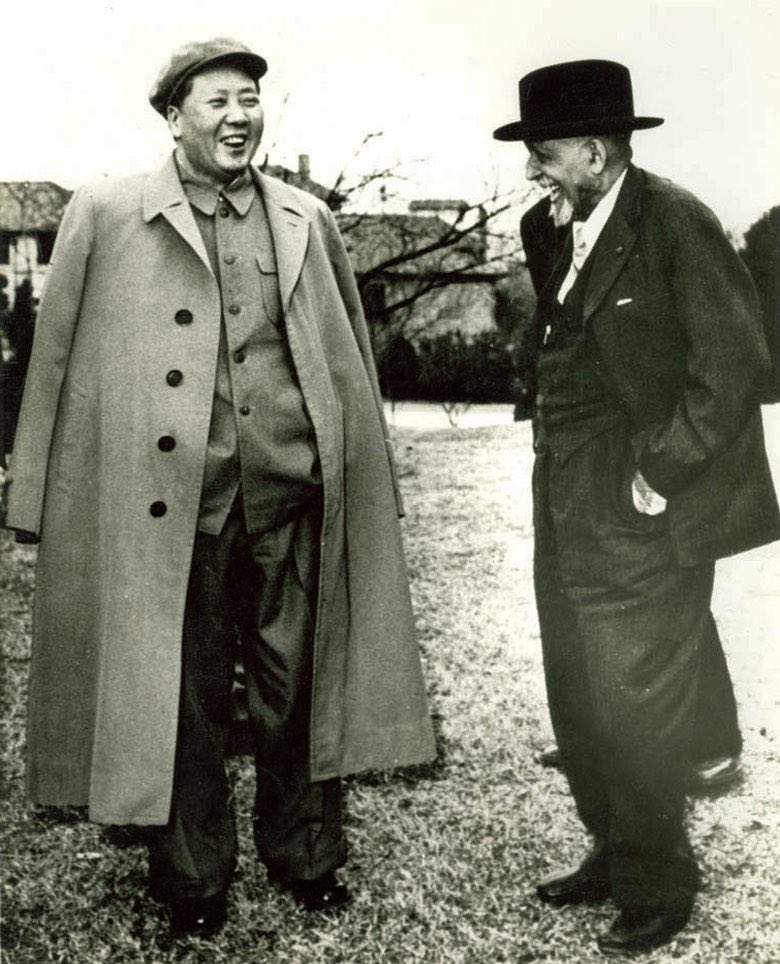
Du Bois and Shirley Graham Du Bois arrived in Beijing on 14 February 1959. Zhou Enlai gave him a ninety-first birthday reception at the Beijing Hotel on 23 February. On 14 March Mao received them at his residence in Wuhan. They travelled on to Chongqing, Chengdu, Kunming, Guangzhou, Shanghai and Nanjing, part of it by boat up the Yangzi.
They went back on 29 September 1962, and on 1 October stood in the reviewing stand at Tiananmen for the thirteenth anniversary of the People’s Republic.
Two passports,
and what was asked for them.
-
August 1950 · Paul Robeson
The State Department cancelled his passport and notified United States border officials to detain him should he attempt to leave the country. On his lawyers’ advice he declined to hand the document over when agents came for it. For the next eight years he could not leave.
-
1951 · W. E. B. Du Bois
He was eighty-three and chairman of the Peace Information Center, which had circulated a petition against nuclear weapons. He and four colleagues were indicted under the Foreign Agents Registration Act for failing to register as agents of a foreign principal. Albert Einstein offered to appear as a character witness. At trial in November 1951 the judge threw the case out once the government had finished putting in its evidence.
-
The condition
The government took his passport and held it for eight years. There was a way to get it back: sign an affidavit stating he was not a Communist. He did not sign it.
The policy behind both was the Secretary of State’s practice of refusing passports to applicants over their beliefs and associations, and over their refusal to file affidavits about membership of the Communist Party.
16 June 1958,
and what it reached.
Kent v. Dulles was decided five to four, Justice Douglas writing. Rockwell Kent, a painter, had been refused a passport under the same policy. The Court held that Congress had never given the Secretary of State authority to withhold a passport because of a citizen’s beliefs or associations, and set the right itself above the practice:
The right to travel is a part of the “liberty” of which the citizen cannot be deprived without due process of law under the Fifth Amendment.
The questions about Communist Party membership came off the passport application. Passports were issued to Kent and to the others who had contested the Department. Robeson got his back that year. The Du Boises applied immediately.
The ruling was about belief. It was not about geography, and it left the area restrictions alone — which is why the passport issued to Du Bois two years later still named five countries on its face. The Court reached that question in 1965, in Zemel v. Rusk, and held that the Passport Act of 1926 did give the executive the authority to restrict a passport by area. The stamp was lawful. It stayed.
A citizen of
somewhere else.
Du Bois moved to Ghana in 1961 at the invitation of Kwame Nkrumah, to direct an Encyclopedia Africana. In early 1963 the United States refused to renew his passport. He took Ghanaian citizenship, and he died in Accra on 27 August 1963, aged ninety-five — the day before the March on Washington.
He had been born in Great Barrington, Massachusetts, three years after the Civil War ended.
Section 402,
Trade Act of 1974.
Eleven years after Du Bois died in Accra, Congress wrote a trade law with an emigration test in it. The provision is named for its sponsors, Senator Henry Jackson and Representative Charles Vanik, and it was drafted against the Soviet Union’s restrictions on Jewish emigration. It denies most-favoured-nation treatment, and American government credits, to any non-market economy of which the President determines the following:
(1) denies its citizens the right or opportunity to emigrate;
(2) imposes more than a nominal tax on emigration or on the visas or other documents required for emigration, for any purpose or cause whatsoever; or
(3) imposes more than a nominal tax, levy, fine, fee, or other charge on any citizen as a consequence of the desire of such citizen to emigrate to the country of his choice.
The President may waive the section. The waiver runs for twelve months and has to be renewed, with a report to Congress, every year.
That waiver is the instrument Volume XII is made of. When the renewal was made conditional by executive order in 1993, the first condition written into the order was that extension “will substantially promote the freedom of emigration objectives of section 402 of the Act.”
Five jurisdictions,
one page.
The five places named on the 1960 passport had all had their most-favoured-nation treatment suspended under the Trade Agreements Extension Act of 1951, which directed the President to withdraw it from every country under the control of international Communism. Truman suspended China’s on 1 September 1951.
Take each one in turn and read when it came back, and under what.
—
Four of the five were restored by waiver of the emigration test. Hungary was first, in July 1978, two years before China. The fifth has never been restored.
What the record
holds.
-
1950–1951
The State Department cancelled one American’s passport and told the border to hold him; took another’s and kept it eight years against an affidavit he would not sign. In the same period Congress directed the President to strip most-favoured-nation treatment from every country under Communist control, and he did, China’s on 1 September 1951.
-
1958
The Supreme Court held that the right to travel is part of the liberty protected by the Fifth Amendment, and that the Secretary had no authority to withhold a passport over belief. Both passports came back. The geography on them did not come off.
-
1959 and 1962
Du Bois went to one of the five named countries, twice, and was received by its head of state and seated on the Tiananmen rostrum.
-
1963
The United States declined to renew his passport. He died a citizen of Ghana.
-
1975 onward
Congress conditioned the trade standing of non-market economies on whether they denied their citizens the right or opportunity to emigrate, or charged them for the desire to. The President may waive it for a year at a time. Hungary 1978, China 1980, Albania 1992, Vietnam 1998. North Korea, never.
From 1990 to 2000 the House of Representatives voted once a year on whether China could keep selling into the American market, under a statute that measures whether a state lets its people go.
Where to check
every line above.
Grouped by the section each one supports.
i. The stamp
The passport, its restriction, and the 1959 and 1962 journeys
- The passport issued 7 June 1960 and its area restriction: W. E. B. Du Bois Papers, Special Collections and University Archives, University of Massachusetts Amherst, item mums312-b160-i094.
- The photograph and the trip: images from the 1959 visit are held in the same collection, Series 17 (Photographs); see for example “Mao Tse-tung greeting W. E. B. Du Bois and Shirley Graham Du Bois,” catalogued China 1959.
- Arrival on 14 February 1959, the birthday reception of 23 February at the Beijing Hotel, the luncheon Mao hosted at Wuhan on 14 March, the provincial itinerary, the return on 29 September 1962 and the Tiananmen reviewing stand on 1 October 1962: “W. E. B. and Shirley Graham Du Bois in Maoist China,” Du Bois Review.
ii. Eight years, twice
The two cancellations, the prosecution and the affidavit
- The cancellation of Paul Robeson’s passport in August 1950 and the instruction to border officials: biographical record, and the contemporary pamphlet “The Case of Paul Robeson’s Passport,” New York Public Library.
- The Peace Information Center indictment under the Foreign Agents Registration Act, the November 1951 trial and its dismissal: a legal retrospective of the trial; Peace Information Center, citing David Levering Lewis.
- The confiscation of Du Bois’s passport, the eight years, and the non-Communist affidavit he refused to sign: biographical record, citing Lewis.
iii. The ruling
What the 1958 decision held, and what it left in place
- Kent v. Dulles, 357 U.S. 116 (1958), decided 16 June 1958, Douglas J.: United States Reports, vol. 357, p. 116.
- The area-restriction question, reached seven years later and decided the other way: Zemel v. Rusk, 381 U.S. 1 (1965), on the Passport Act of 1926 — case record.
v. The test, written down
Section 402, its three limbs and its annual waiver
- The text of the emigration test and the twelve-month waiver: Congressional Research Service, “The Jackson-Vanik Amendment: A Survey” (98-545).
- The condition quoted from Executive Order 12850, 28 May 1993, §1(a): reproduced in Volume XII.
vi. The instrument
The 1951 suspension and each of the five restorations
- The Trade Agreements Extension Act of 1951 and Truman’s suspension of China’s most-favoured-nation status as of 1 September 1951: Congressional Research Service, “Most-Favored-Nation Status of the People’s Republic of China” (RL30225).
- Restoration dates and mechanisms for each country — Hungary July 1978, China February 1980, Albania November 1992, Vietnam April 1998, and North Korea’s exclusion: Congressional Research Service, “Normal-Trade-Relations (Most-Favored-Nation) Policy of the United States” (RL31558).
- The December 1950 embargo and the Foreign Assets Control Regulations issued under §5(b) of the Trading With the Enemy Act, covering transactions related to travel, and their lifting on 7 May 1971: Congressional Research Service, “China: U.S. Economic Sanctions” (96-272).
Visual direction after the oceanographic films of Jacques-Yves Cousteau and the crew of the R.V. Calypso, 1943–1996. The saucer is the SP-350 “Denise”. No affiliation; the debt is the point.