Thirteen
Key Countries.
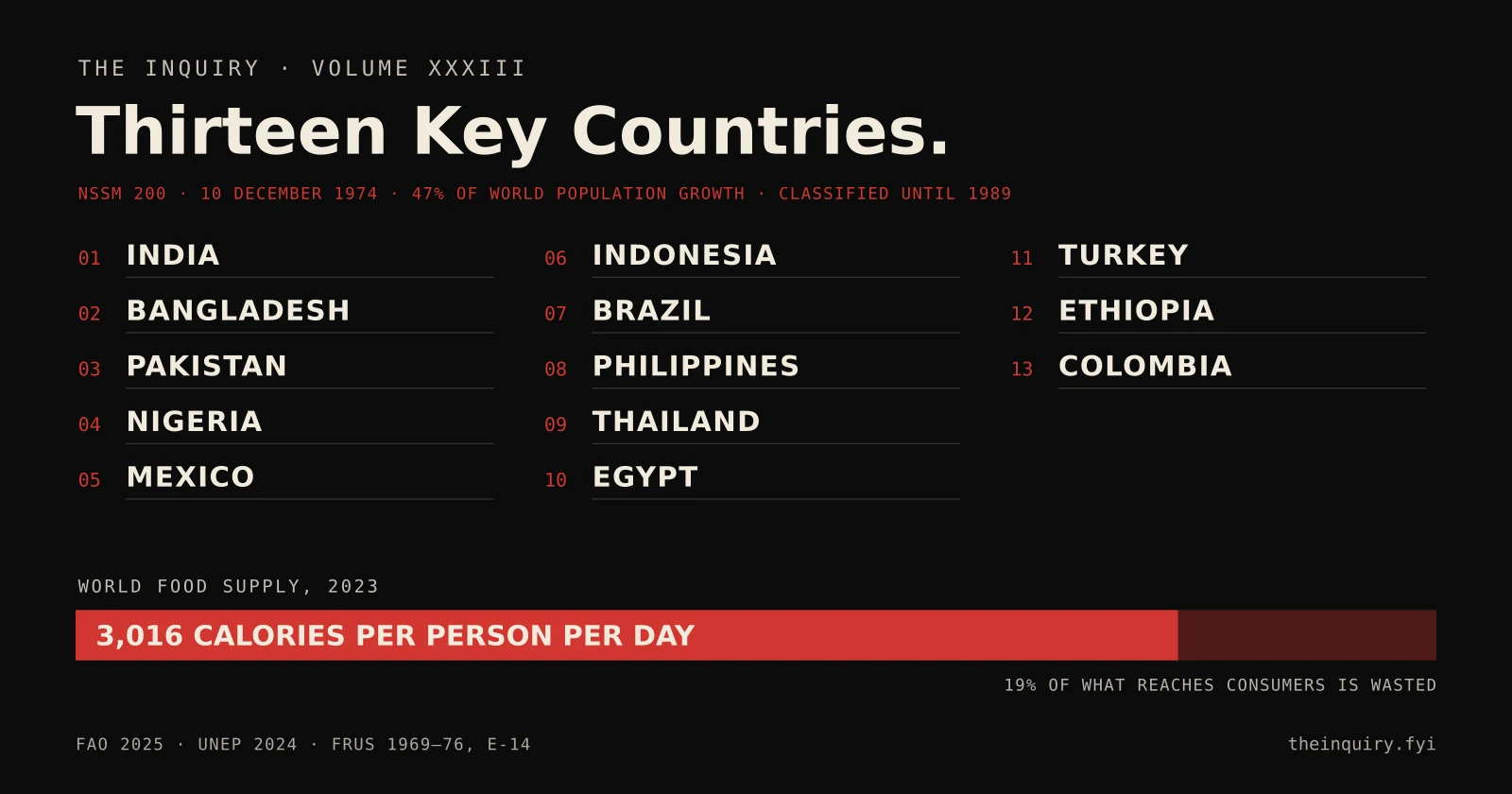
For two centuries the poor have been told there is not enough food, and that the answer is fewer of them. The world now grows more than three thousand calories a day for every person alive, wastes a fifth of what reaches the shops, and still leaves hundreds of millions hungry. The same foundations that paid to grow more food paid to make fewer people. A 1974 security study named the thirteen countries whose births mattered most to Washington, a World Bank president asked borrowing governments for a plan to slow their population growth, and millions of women and men were sterilized, most of them poor, Indigenous, disabled or colonized. The richest members of the G20 did it at home too.
Thirteen countries,
almost half the growth.
On 24 April 1974 the White House ordered a study of what world population growth meant for American security and overseas interests. The report, National Security Study Memorandum 200, is dated 10 December 1974. It named thirteen key countries that together held almost half, 47 per cent, of the world’s population growth: India, Bangladesh, Pakistan, Nigeria, Mexico, Indonesia, Brazil, the Philippines, Thailand, Egypt, Turkey, Ethiopia and Colombia. Its summary for the President warned that crop failures anywhere would raise the possibility of massive famines in the developing world.
“Thirteen key countries which contribute almost half the present population growth.”Henry Kissinger, memorandum to President Ford, 16 October 1975
President Ford adopted it as policy on 26 November 1975, in National Security Decision Memorandum 314. The study stayed classified until 1989. Six years before it, on 5 December 1968, the new president of the World Bank, Robert McNamara, had told the United Nations that “we must put population policy at the center of our future strategy,” and that the Bank would “ask that governments which seek our assistance do so too.” A lender to poor countries had made their birth rates part of the terms.
The record,
dated.
Sixteen entries, 1798 to 2026. The hinge rows are the ones where someone with money or power decided who should be born.
Not enough food,
on paper.
The argument is old. In 1798 Thomas Malthus wrote that population grows geometrically and food only arithmetically. In 1968 Paul Ehrlich’s The Population Bomb told readers that in the 1970s “hundreds of millions of people are going to starve to death.” They did not. In 2023 the world’s food supply crossed three thousand calories per person per day for the first time: 3,016, by the count of the UN Food and Agriculture Organization.
Then it is thrown away. The FAO finds that 13.2 per cent of food is lost between the farm and the shop. The UN Environment Programme counted 1.05 billion tonnes wasted in 2022, 19 per cent of the food that reached consumers, 132 kilograms for every person on earth. In 2024 about 673 million people went hungry. The food exists. It does not reach them.
Bengal in 1943 is where that was proved. Amartya Sen, who won the Nobel prize in economics in 1998, found that Bengal had about 9 per cent more food per person in 1943 than in 1941, and that perhaps three million people died. The government’s own inquiry counted about 1.5 million. In 1942 the British administration had taken the boats and the rice out of the coastal districts, to deny them to a Japanese invasion that never came. In March 1943 it lifted price controls; in May it declared free trade in rice. In Calcutta a maund of coarse rice went from under six rupees in January 1942 to fifteen in March 1943 and about thirty-one by mid-May. Wages did not follow. Between January and July 1943, India exported 71,000 tons of rice. In August the War Cabinet in London offered a token shipment of grain.
“It lay in the power of the Government of Bengal” to have largely prevented it.Famine Inquiry Commission, report on Bengal, 1945
Sen’s finding is that famine is a matter of who can buy, not of how much exists. Scarcity that the record does not show has to be produced by policy, prices and control of access, and then it can be blamed on the number of mouths.
More food,
fewer people.
The same money paid for both. In 1943 the Rockefeller Foundation signed an agreement with Mexico that became its Mexican Agricultural Program, the root of the maize and wheat centre CIMMYT. In 1959 the Ford and Rockefeller foundations laid the groundwork for the International Rice Research Institute in the Philippines. Those are the institutions of the Green Revolution, which grew the surplus.
In 1952 John D. Rockefeller 3rd founded the Population Council. Between 1954 and 1968, grants from the Ford Foundation made up more than 40 per cent of its budget, and at its 1966 peak Ford’s own population budget was $25 million a year. American government spending on population programmes went from $2.1 million in 1965 to $117.5 million in 1970 and $354.3 million in 1980. The World Bank turned McNamara’s words into credits: Tunisia in 1971, then Indonesia, $13.2 million on 20 April 1972, and two Indian states on 14 June 1972.
The conversation did not end with the Cold War. In May 2009, the Sunday Times reported a private meeting in New York convened at Bill Gates’s initiative, with Warren Buffett, David Rockefeller Jr., George Soros, Michael Bloomberg, Ted Turner and Oprah Winfrey, at which overpopulation was agreed to be a priority. Turner said on American television in 2008: “We’re too many people.” In 2013 he said the world’s population must be stabilized at near two billion. There are more than eight billion people alive.
Targets,
then quotas.
India is first on the list. During the Emergency, the government’s own figures count 2,624,755 sterilizations in 1975–76 and 8,132,209 in 1976–77, against a target of 4,255,500. The commission that investigated afterwards counted 1,774 deaths linked to sterilization. Most were vasectomies. The camps outlived the Emergency. In November 2014 thirteen women died after a camp in Bilaspur, Chhattisgarh, where 137 operations were done. In 2016 the Supreme Court ordered the camps closed and the targets dropped; the health ministry’s own data showed 363 deaths from sterilization in 2010 to 2013.
Brazil is on the list. The share of married women who were sterilized rose from 27 per cent in 1986 to 40 per cent in 1996, and to 44 per cent in the Northeast, where politicians and doctors arranged and paid for seven in ten tubal ligations, in exchange for votes. A congressional inquiry in 1992 and 1993 found that the clinic network doing much of it had been funded first by the UN Population Fund and then by the American aid agency. Mexico is on the list: in April 1998 a state health brigade in Guerrero sterilized fourteen Indigenous men in El Camalote, and the national human rights commission called it forced contraception. Indonesia is on the list, and took the World Bank’s money in 1972.
Peru was not on the list. From 1996 to 2000 its health ministry counted 215,227 tubal ligations and 16,547 vasectomies; the ombudsman’s count is 272,028 women and 22,004 men, recruited against quotas set by region and by hospital. A 1998 hearing in the US Congress called the American aid program there the largest in the Western Hemisphere. In 2002 Peru’s own health minister said at least 200,000 were done without consent or under pressure. In October 2024 the UN committee on women’s rights said the campaign could constitute a crime against humanity. On 5 March 2026 the Inter-American Court ruled for the family of Celia Ramos, who died nineteen days after her operation in 1997.
China ran its own program, and the numbers are its own: 21 million sterilizations in 1983 alone, and 196 million since 1971 by the health ministry’s count. In Xinjiang the birth rate fell from 15.88 to 8.14 per thousand between 2017 and 2019. In 2018 the region recorded 243 sterilizations per 100,000 people, against 32.1 for China as a whole. The UN human rights office found coercion a likely cause.
The lenders
did it first.
The countries that paid for population control abroad had already practised it on their own poor. In 1927 the United States Supreme Court upheld forced sterilization in Buck v. Bell: “Three generations of imbeciles are enough.” More than 60,000 Americans were sterilized under the laws of 32 states. In 1974 a federal court found that between 100,000 and 150,000 poor people a year were being sterilized under federally funded programs; the case began with two Black girls in Alabama, aged twelve and fourteen. In 1976 the government’s auditors counted 3,406 sterilizations of Native American women in four Indian Health Service areas in under four years, on consent forms that did not meet the rules. California’s prisons sterilized 144 women between 2005 and 2013.
Canada did it under law and then without one. Alberta’s Sexual Sterilization Act ran from 1928 to 1972 and its Eugenics Board approved about 2,800 sterilizations; in its last years about a quarter of them were Indigenous. British Columbia had its own act until 1973. In Saskatoon, an external review in 2017 heard sixteen Indigenous women describe being coerced into tubal ligation, most of them between 2005 and 2010. The Senate’s human rights committee heard of a case in December 2018, and its 2022 report found cases as recent as 2019 and class actions in eight provinces.
Japan’s Eugenic Protection Law ran from 1948 to 1996; about 25,000 people were sterilized, at least 16,500 of them by force. On 3 July 2024 its Supreme Court ruled the law unconstitutional from the day it was passed. Germany sterilized 350,000 to 360,000 people under its 1933 law, and 5,000 to 6,000 women and about 600 men died of the operations. On the French island of Réunion, a clinic carried out abortions and sterilizations on poor women without their consent from at least 1966; only 36 abortions were ever prosecuted, and the women who sued lost. Britain and Italy passed no sterilization law; Britain’s answer was the 1913 Mental Deficiency Act, which detained people in institutions instead.
Who was cut,
member by member.
The G20 and the European Union, against five questions: the law or programme, how many people, who it fell on, whose money paid, and what a court or government has said since. Pick a column and each member shows what the record holds. An empty row is a member where we found nothing on the record, not a member that is clear of it.
Never the people
who paid.
The record holds one argument and one answer. The argument is scarcity: Malthus in 1798, Ehrlich in 1968, a security study in 1974. The record does not show it. Bengal starved with more food than it had two years before, and the world now grows more than three thousand calories a day for every person and throws a fifth of it away.
The answer was fewer people, and it was always somebody else’s people. The foundations that grew the surplus funded the clinics. The lender made birth rates a condition. The quotas fell on Indian men in camps, on women recruited by quota in Peru, on Indigenous women in Alberta, in Saskatoon and in Indian Health Service hospitals, on Black girls in Alabama, on disabled people in Japan and Germany, on women in prison. No member of the G20 sterilized its rich.
Declared: “thirteen key countries,” almost half the growth.
Disproved: 3,016 calories a person a day, a fifth thrown away.
Settled: on the bodies of the poor, by quota.
Where to check
every line above.
The order
- Foreign Relations of the United States, 1969–76, vol. E-14, doc. 118: NSSM 200 summary, December 1974; doc. 121, Kissinger to Ford, 16 October 1975; doc. 122, NSDM 314, 26 November 1975
- World Bank, first loan for family planning, Jamaica; World Bank timeline, Tunisia population credit, 1971; Robert McNamara, address to the UN Economic and Social Council, 5 December 1968
The surplus
- FAO, Food balance sheets 2010–2023; FAO, food loss and waste; UNEP, Food Waste Index Report 2024; The State of Food Security and Nutrition in the World 2025
- Thomas Malthus, An Essay on the Principle of Population, 1798; Kenneth Arrow on Sen’s Poverty and Famines, New York Review of Books, 1982; Famine Inquiry Commission, 1945; Banglapedia, Famine of 1943; Outlook, on Madhusree Mukerjee’s Churchill’s Secret War
The money
- Rockefeller Archive Center, the Mexican Agricultural Program; FAO, on the founding of IRRI; Rockefeller Archive Center, John D. Rockefeller 3rd; Rockefeller Archive Center, the Ford Foundation and the Population Council; Perrin Elkind, dissertation, University of California, 2015
- World Bank, Indonesia population credit 300-IND; Sunday Times report on the May 2009 meeting; The Observer, 2009; UPI, Ted Turner, 2008; Bridgespan, Ted Turner, 2013
The thirteen and Peru
- Government of India, Lok Sabha reply on Emergency sterilizations, citing the Shah Commission, 2025; Supreme Court of India, Devika Biswas v. Union of India, 2016
- Population Reference Bureau, Brazil case study; André Caetano, IUSSP, 2001; Pesquisa FAPESP on the 1992–93 inquiry; CNDH Mexico, Recommendation 66/2007
- US House, The Peruvian Population Control Program, 25 February 1998; UPI, Peru’s health minister, 2002; UN CEDAW committee on Peru, October 2024; AP, Inter-American Court, Celia Ramos, March 2026
- Judith Banister, One-Child Policy, Encyclopedia of Population; China health ministry totals, as reported in 2013; UN human rights office, assessment on Xinjiang, 31 August 2022
At home
- Buck v. Bell, 274 U.S. 200 (1927); Stern et al., American Journal of Public Health, 2017; SPLC, Relf v. Weinberger; GAO, HRD-77-3, 4 November 1976; California State Auditor, report 2013-120
- The Canadian Encyclopedia, Sterilization of Indigenous Women in Canada; Government of Alberta, 10 March 1998; Senate of Canada, Forced and Coerced Sterilization of Persons in Canada, 2021; Senate of Canada, The Scars that We Carry, 2022
- Min-iren, on the Supreme Court ruling of 3 July 2024; Tansa, Japan’s eugenic sterilizations; Bundestag, Drucksache 16/3811, 2006; Assemblée nationale, resolution no. 1517 on Réunion, 2018; Hansard, 13 April 1937; Pathologica, eugenics in Italy, 2023
The members, for the instrument
- Amnesty International, Czech compensation law, 2021; European Court of Human Rights, V.C. v. Slovakia, 2011; TimesLIVE, Commission for Gender Equality report, 2020; SBS, Australian Senate inquiry, 2013
- Supreme Court of Korea, 2014Da230535, 2017; Seoul Shinmun, 1999; IPS, East Timor, 1997; Human Rights Watch, Argentina, 2005; Meduza, Yekaterinburg care home, 2020
Visual direction after the oceanographic films of Jacques-Yves Cousteau and the crew of the R.V. Calypso, 1943–1996. The saucer is the SP-350 “Denise”. No affiliation; the debt is the point.