Advised
Against.
In December 2020 the Government of Canada had been telling its citizens for nine months to avoid all travel outside the country, and Ontario was days from a province-wide order to stay home. Over the holidays a finance minister flew to St. Barts and posted a Christmas video by a fireplace, a Senate leader who had recorded “we cannot travel” flew to Mexico, and at least twenty-five other office-holders left the country. Every one of them was caught by somebody who saw them. The Prime Minister was seen by nobody for twelve days, and the record that would show where he was has never been published. In London, the people who wrote the rules held the parties. The record of all three, and the document that would close the gap, follow.
Advice for the office,
orders for everyone else.
The pandemic rules came in two registers. For the people who wrote them they were advice: avoid non-essential travel, set an example, and if you are seen ignoring it, give up a committee seat. For everyone else they were orders, with police to enforce them and fines measured in thousands of dollars or pounds. This volume reads both registers against the record, in three places: the departures from Canada over the holidays of 2020, the twelve days in that same holiday when no one saw the Prime Minister, and the gatherings at Number Ten.
The first is the plainest. At least twenty-seven Canadian office-holders and senior officials left the country while it was being told to stay home, and every one of them was found out because somebody saw them. The third is settled by a police operation and a parliamentary report. The second is the one that turns on a document. For twelve days no independent witness placed the Prime Minister anywhere, the publication meant to log government flights does not reach back that far, and the record that would settle it sits in a release nobody has read aloud.
The record,
dated.
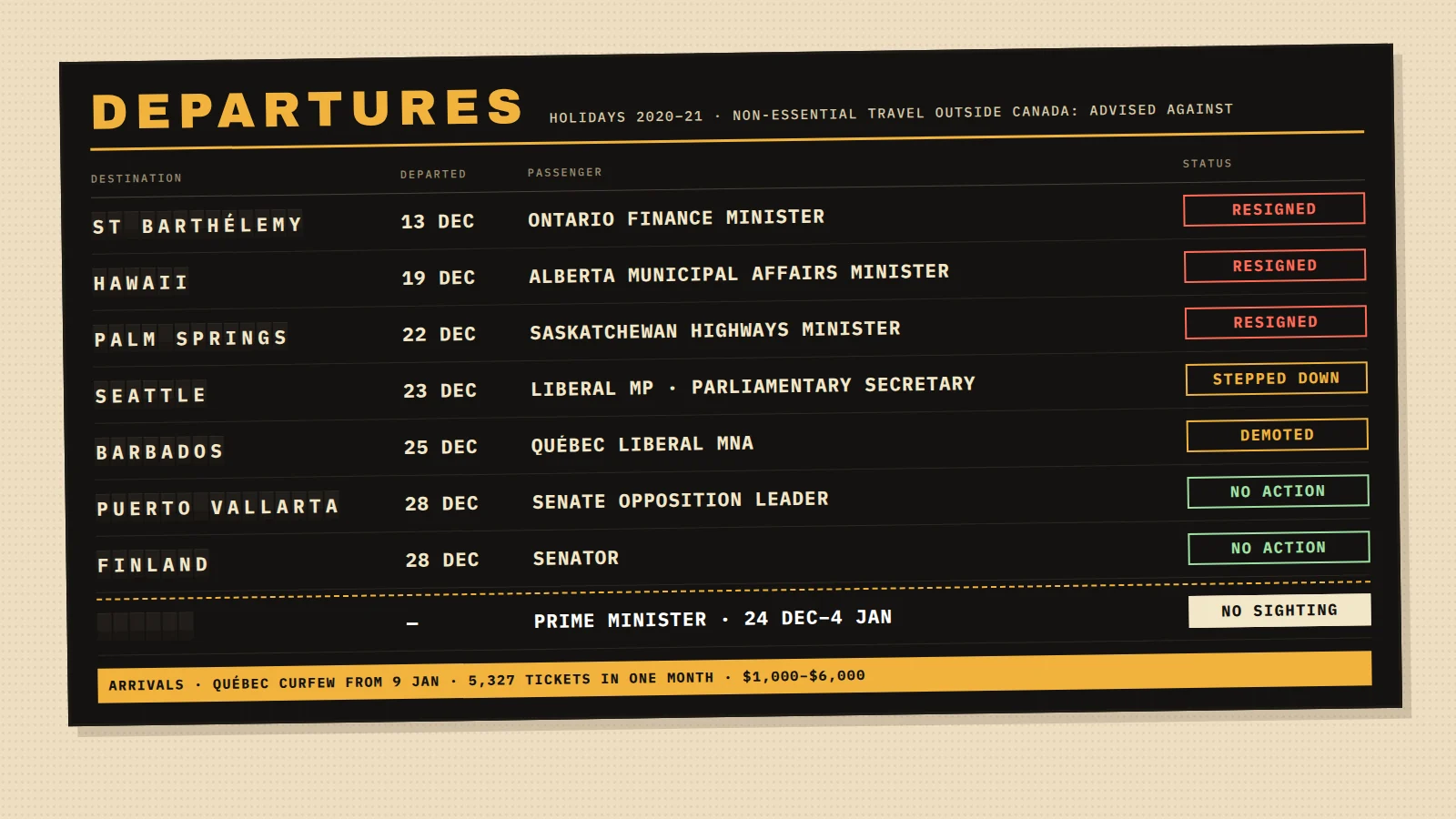
Nineteen entries. The hinge rows are the ones where the rule and the conduct sit side by side.
Three findings,
one open document.
- Twenty-seven departures. At least twenty-seven Canadian office-holders and senior officials, from every major party and every level of government, left the country over the holidays of 2020 while non-essential travel was advised against. A finance minister by a fireplace in St. Barts; a Senate leader who recorded we cannot travel, then flew. Each was found out by someone who saw them, and the only penalties were their parties’ decisions.
- Twelve days, no witness. From 24 December 2020 to 4 January 2021 no independent witness saw the Prime Minister. What placed him at home was his office’s statement, a reporter’s sources and two undated videos. Nothing in the record places him outside Canada; nothing independent places him inside it. The government’s published flight log begins ten months later.
- Two registers. At Number Ten, 126 fines for 83 people. Across England, about 107,000 fines, 374 of them at £10,000, falling hardest on the young and the poor. In Canada, demotion for the office-holders who flew, and five thousand curfew tickets in Quebec in a single month.
Departures:
twenty-seven, and how each was caught.
The advice was unambiguous and nine months old. On 13 March 2020 Global Affairs Canada told Canadians to avoid non-essential travel outside the country until further notice, and the notice never lapsed that year. On 21 December Ontario announced a province-wide shutdown from Boxing Day: stay home unless you need to go out for essentials. Alberta had banned every indoor and outdoor social gathering on 8 December, with thousand-dollar fines.
Rod Phillips, Ontario’s finance minister, left for St. Barts on 13 December and stayed until the 31st. On Christmas Eve he posted a video of himself beside a fireplace, thanking Ontarians for the sacrifices they were making, in a way that, as CBC put it, could arguably give the impression he was home. Asked about it afterwards, he said what was true of the whole political class: “Most politicians pre-program and pre-record.” Alberta’s municipal affairs minister went to Hawaii; the Premier’s own chief of staff to the United Kingdom; five more government MLAs to Hawaii, Phoenix, Las Vegas and Mexico. Saskatchewan’s highways minister went to Palm Springs to finalize the sale of a house that, the opposition showed, was listed for sale only on 26 December.
In Ottawa: a Liberal parliamentary secretary to Seattle, another Liberal MP to Delaware, a Conservative MP who stayed in the United States “for leisure” without telling his whip, an NDP MP to Greece. In Quebec, a Liberal MNA to Barbados and a CAQ MNA to Peru. Four senators, among them the Conservative leader, Don Plett, who had co-signed Parliament’s own travel moratorium in March, recorded a Christmas greeting on 17 December saying we cannot travel and gather as we normally would, and flew to Puerto Vallarta on the 28th. Two Pickering councillors, the chief of staff to Calgary’s mayor, the chair of Winnipeg’s health authority, a hospital chief executive who sat on Ontario’s COVID-19 science table.
None of it was illegal. Leaving the country was advised against, not prohibited, and every penalty that followed was a party’s or an employer’s decision: a cabinet minister and the Premier’s chief of staff out in Alberta, a minister each in Ontario and Saskatchewan, demotions everywhere else, and nothing at all for the senators. That is the finding, not a defence. In the same weeks Ontario was ticketing house parties at $880 a head and Quebec, from 9 January, ticketing people out after eight at night. Advice for the office; orders, and fines, for everyone else.
One more thing is in the record, and it matters for what follows. Every one of these departures came to light because somebody saw. A radio station in Toronto. A witness at a hotel in Barbados who called Radio-Canada. An American couple who recognized a Canadian senator at a pool in Mexico. A resident who emailed Pickering council. Not one was found from a log.
The twelve days:
no sighting, no log, one voucher.
The Prime Minister flies the Royal Canadian Air Force’s Challenger jets and its Airbus, military aircraft whose transponders are broadcast and whose use is released under access to information. When his itinerary placed him in Ottawa on the first National Day for Truth and Reconciliation in September 2021, a Challenger was tracked landing in Tofino, his office confirmed he was there within hours, and he later called the trip a mistake. The logs get read when somebody looks.
Over the holidays of 2020 a story did circulate that he was in Barbados. It began with an anonymous website and a photograph of a Challenger landing on the island, a jet that, by the flight data reported at the time, had come from Puerto Rico. Nothing in the record places him outside Canada. But set the Prime Minister’s own published itineraries beside the record of who saw him. On 23 December, at one in the afternoon, he spoke outside Rideau Cottage to the press gallery, hours after the Moderna approval. The next time anyone outside his household and his office saw him was 5 January at a quarter past eleven, at the same door. In between, the itineraries read Personal or Private meetings, two recorded interviews aired and two recorded messages were posted: one filmed outside the house, one in his office, neither with a date of recording. Twelve days, with no witness anywhere.
What filled them was three things. His office’s statement that he had not travelled and spent the holidays with his family at home, though it would not say which home. A tweet from Glen McGregor of CTV placing him at Harrington Lake, which he told the wire service was based on reliable sources: a source, not a sighting. And the two videos, neither of which carries a date. That was enough for a fact-check to rate the Barbados rumour false, and on the evidence that existed the rumour was false. It was not enough to place him.
The reporter’s employer is part of the record too. The Canada Revenue Agency’s own registry names Bell Media Inc. as a claimant of the Canada Emergency Wage Subsidy, and BCE’s audited report for 2020 says the subsidy lowered Bell Media’s labour costs and “mitigated the impact on our media employees.” BCE took about $122.9 million across the group that year and paid its shareholders $2.975 billion. Whether Bell was still claiming in January 2021 is not established; BCE books the subsidy as a 2020 benefit. But the newsroom that vouched for the Prime Minister’s whereabouts had, that year, a payroll the federal government helped to meet.
Here is the asymmetry. Twenty-seven office-holders were caught by people who saw them, and penalized on that evidence. The one office-holder who was seen by nobody was cleared on the word of his own staff. The government’s published record of who flew on its aircraft begins in October 2021, ten months too late. The record that would close the question does exist: National Defence’s monthly reports on VIP flights, with itineraries and passenger manifests, from October 2019 to December 2022, released under access request A-2023-01795 in April 2025. It runs to 154 pages, and anyone can ask for it at no cost. If a government aircraft carried the Prime Minister anywhere between 24 December 2020 and 4 January 2021, it is on those pages.
The witness calendar:
who saw him, day by day.
Twenty-two days from the Prime Minister’s published itineraries, 18 December 2020 to 8 January 2021. Each day is marked by the best evidence of where he was: a witness, a recording, his office’s word, or nothing. Tap a day.
Number Ten:
126 fines inside, 107,000 outside.
The British half of the charge has a word in it that comes from Downing Street itself. In September 2012 the government chief whip, Andrew Mitchell, had a row with the police officers at the Downing Street gate, and a judge later found he had probably called one of them a pleb. Eight years later the gate was the boundary of a different kind of privilege.
On 20 May 2020, when people in England could meet one other person outdoors and no more, the Prime Minister’s principal private secretary invited about two hundred staff to the garden of Number Ten: bring your own booze. On 19 June there was a birthday gathering for Boris Johnson in the Cabinet Room. On 16 April 2021, the night before Prince Philip’s funeral, there were two leaving parties in the building, and the next day the Queen sat alone in St George’s Chapel because the rules capped funerals at thirty. Sue Gray’s report counted sixteen gatherings and laid the responsibility on the senior leadership at the centre.
The Metropolitan Police issued 126 fixed penalty notices to 83 people, the Prime Minister and his Chancellor among them. Johnson was the first sitting Prime Minister found to have broken the law. Set against the country: about 107,000 notices in England over the pandemic, 374 of them at ten thousand pounds for organizing a gathering, and a study at the University of Edinburgh found the young and the poor far more likely to be fined. The fines at Number Ten were the ordinary kind. None was the ten-thousand-pound kind, though the garden party had two hundred invitations.
Did it cost him an election? No. He won a confidence vote among his own MPs in June 2022, 211 to 148. He went in July, when some sixty ministers and aides resigned over a different scandal, and he left Parliament in June 2023 rather than face a ninety-day suspension after a committee of MPs found he had deliberately misled the House. His party held his seat at the by-election by 495 votes. The voters’ verdict came later and wholesale, with the parties among the reasons local Conservatives gave for it: a safe seat lost in North Shropshire, nearly five hundred council seats in May 2022, and in 2024 the fewest Conservative MPs ever elected. The rules did reach him in the end. They reached him slowly, gently, and through his own side.
A board of departures,
and one blank line.
There is a word for this, and it is club. The rules of the pandemic came in two registers. For the office, they were advice: avoid travel, set an example, and if you are seen breaking it, step down from a committee. For everyone else they were orders, with police to enforce them and fines measured in thousands. The office-holders who flew in December 2020 did not break a law, and that is the finding. They wrote the advice, ignored it, and were judged by their own parties.
The Prime Minister is the hardest case and the most instructive. Nothing in the record puts him outside Canada. Nothing independent puts him inside it for twelve days either, and the system that cleared him was his own office’s statement, a reporter’s sources at a subsidized newsroom, and two undated videos. The other twenty-seven were caught because ordinary people saw them and said so. The one who could not be seen was checked by nobody with a document. That document is named above. It is 154 pages long, it has already been released, and it costs nothing to ask for.
Twenty-seven departures, each one seen by somebody.
Twelve days with no witness, cleared on the word of the office.
One hundred and fifty-four pages, released, and still unread.
Where to check
every line above.
Grouped by the count each one supports.
iv. Departures
The advice, the orders, the travellers, the tickets
- Global Affairs Canada, “Government of Canada advises Canadians to avoid non-essential travel abroad”, 13 March 2020.
- Government of Ontario, province-wide shutdown, announced 21 December 2020, in effect 26 December; CBC, Alberta’s gathering ban and the UCP trips.
- CBC, Rod Phillips in St. Barts and the timeline of his posts, December 2020.
- CBC, Alberta resignations and demotions, 4 January 2021; Joe Hargrave; Pierre Arcand.
- CBC, Liberal MPs step down from House roles; the federal and Quebec travellers; Niki Ashton.
- CBC, Senator Don Plett in Mexico and the Senate caucus leaders, January 2021.
- Global News, Quebec curfew tickets, 8 February 2021.
v. The twelve days
The itineraries, the videos, the voucher, the payroll, the manifests
- Prime Minister of Canada, itineraries for 18 December 2020 to 8 January 2021; the Christmas message of 24 December and the New Year’s message of 31 December 2020.
- AFP, “Justin Trudeau did not go to Barbados”, January 2021: the Prime Minister’s Office statement and Glen McGregor’s account of his sources.
- The Globe and Mail, “Trudeau criticizes politicians who travelled abroad”, 5 January 2021.
- Global News, Tofino, 30 September 2021, and the apology; Bob Mackin, The Breaker, on the Challenger’s times.
- Canada Revenue Agency, Canada Emergency Wage Subsidy registry: Bell Media Inc. and BCE Inc.; BCE Inc., 2020 Management’s Discussion and Analysis; MobileSyrup, relaying the Toronto Star, 8 February 2021.
- Government of Canada, Proactive disclosure: use of administrative aircraft; National Defence, completed access request A-2023-01795, April 2025, with the form to request a copy at no cost.
vii. Number Ten
The gatherings, the fines, the country, the exit
- Sue Gray, Findings of the Second Permanent Secretary’s investigation into alleged gatherings on government premises during Covid restrictions, 25 May 2022.
- LBC, Operation Hillman closed, 126 fines, 19 May 2022; National Police Chiefs’ Council, fixed penalty notices issued under the Covid-19 regulations, 16 March 2022; University of Edinburgh, who was fined, 2023.
- House of Commons Committee of Privileges, Matter referred on 21 April 2022: final report, HC 564, 15 June 2023; the resignation statement, 7 July 2022.
- Durham Constabulary, statement on Dominic Cummings, 28 May 2020; Press Gazette, the 2012 “pleb” ruling.
- London Borough of Hillingdon, Uxbridge and South Ruislip by-election results, 20 July 2023; UK Parliament, North Shropshire by-election, 16 December 2021.
Visual direction after the oceanographic films of Jacques-Yves Cousteau and the crew of the R.V. Calypso, 1943–1996. The saucer is the SP-350 “Denise”. No affiliation; the debt is the point.