Minors in the
Eyes of the Law.
On 17 January 1918 the federal cabinet exempted First Nations men from combatant service. They could not vote, and their treaties had been negotiated on the promise that they would not be called to fight. More than four thousand enlisted anyway, about 35 per cent of the men of military age, from reserves run through a pass system, a permit system and relief rationed by the Indian agent. When they came home, the government took over 85,000 acres of reserve land to settle other veterans, lent First Nations veterans money out of their own bands’ funds, and took the power to strip their status without consent.
Exempted,
17 January 1918.
The Military Service Act became law on 29 August 1917. It made men from 20 to 45 liable to be called up. That autumn, petitions reached Ottawa from Six Nations, from the Tsimshian at Port Simpson and from the Nisga’a on the Naas River. Their argument was short: they had no vote and no say in the laws of Canada, and their treaties had been negotiated on the Crown’s word that they would not be sent to fight its wars. At the Treaty 3 negotiations in 1873 the Lieutenant Governor had said: “The English never call the Indians out of their country to fight their battles.”
On 17 January 1918 the cabinet passed Order in Council P.C. 111. It recited the petitions, the lack of a vote and the Treaty 3 promise, and exempted Indians from combatant service. An Indian agent could apply for a certificate of exemption for any man on his reserve. The deputy head of Indian Affairs, Duncan Campbell Scott, set out the reasoning a year later: the Indians, “although natural-born British subjects, were wards of the Government, and, as such, minors in the eyes of the law.” Without the vote or the other privileges of citizenship, “they should not be expected to assume responsibilities equal to those of enfranchised persons.”
“Wards of the Government, and, as such, minors in the eyes of the law.”Duncan Campbell Scott, “The Canadian Indians and the Great World War,” 1919
Scott had held that the Military Service Act applied to all Indians. The Royal Commission on Aboriginal Peoples found in his files that he did not publicize the exemption, and that by mid-1918 he was arguing Indians should not be allowed to volunteer at all. This volume follows the men the order covered: who went, from what conditions, and what the government did with them when they came back.
The record,
dated.
Sixteen entries. The hinge rows are the ones where the government decided what the men and their land were owed.
More than
four thousand.
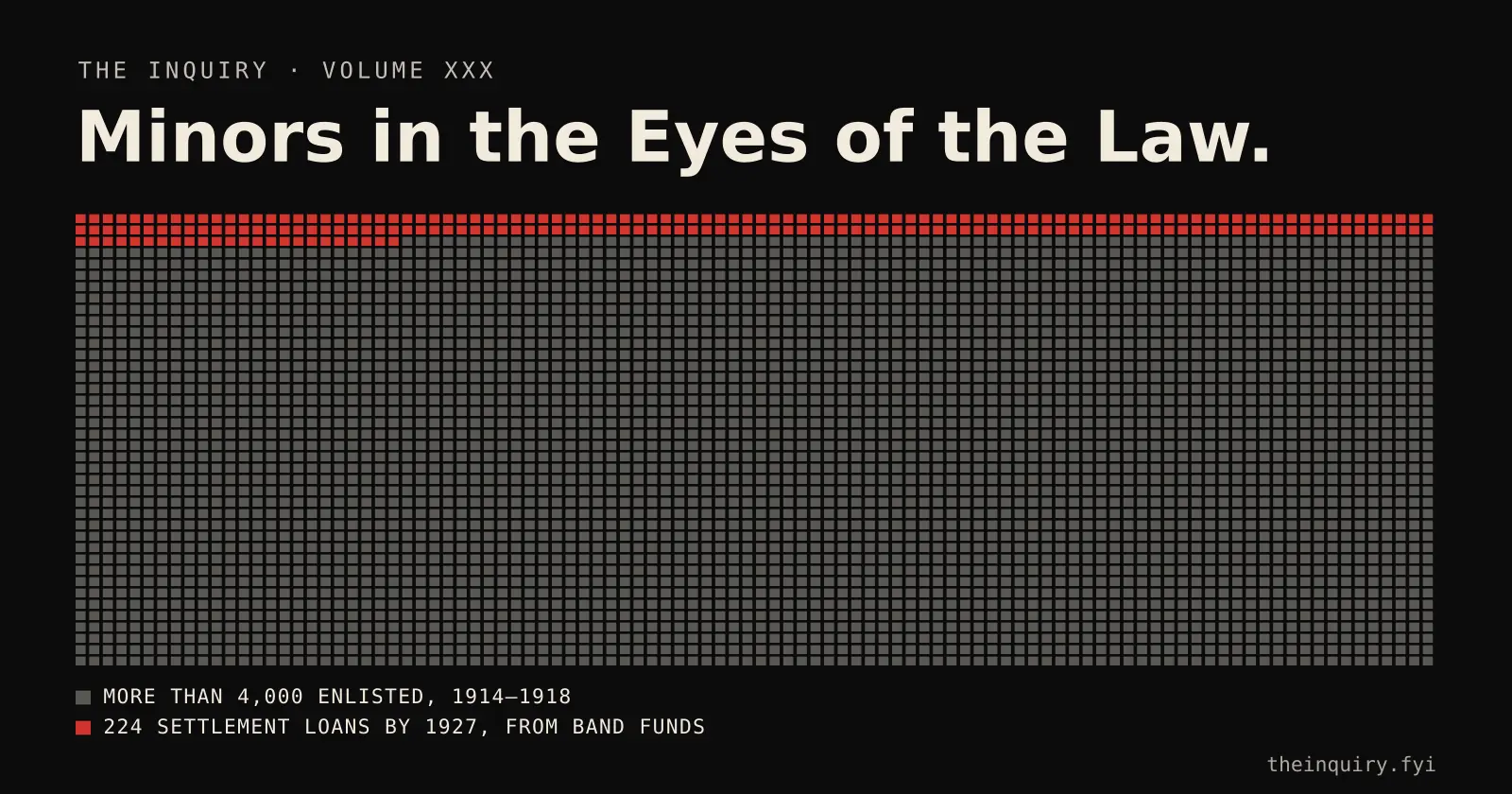
The Department of Indian Affairs kept count. Its report for the year ending March 1916 listed 1,187 men. The next year it put the minimum at 2,000, out of no more than 15,000 men of military age. By March 1918 it had recorded more than 3,500. Its report for the year ending March 1919 gave the final figure: “more than four thousand Indians enlisted for active service with the Canadian Expeditionary forces,” about 35 per cent of the men of military age in the nine provinces. The same report added that “their services were absolutely voluntary, as they were specially exempted from the operation of the Military Service Act.”
Some communities sent almost every man they had. Six Nations sent 292; 29 were killed in action. At File Hills in Saskatchewan, 24 of 38 adult men enlisted. All eight adult men of the Mississaugas of Scugog went. At Golden Lake, 29 went, “leaving only three men on the reserve.” At Cape Croker it was 67 of 108. More than 300 died in the war. Corporal Francis Pegahmagabow of Wasauksing won the Military Medal and two bars, and was credited by the department with 378 enemy killed as a sniper.
Passes, permits
and relief.
The men came from reserves run by the Indian agent. On the prairies, a First Nations farmer could sell his own grain, root crops or other produce only under the government’s rules: an amendment to the Indian Act assented on 21 March 1881 let the cabinet prohibit or regulate the sale of reserve produce, and declared any sale outside the rules “absolutely null and void.” From 1885 a pass system kept people on their reserves unless the agent signed a pass. Its author, Hayter Reed, wrote that he knew it was “hardly supportable by any legal enactment.” Passes were still in use in some areas in the 1930s.
During the war itself, Ottawa took over the reserve land the men left behind. An amendment assented on 24 May 1918 let the Superintendent General lease uncultivated reserve land “without a surrender,” and spend a band’s capital without its consent. The department said the change was intended to expedite its Greater Production campaign. By March 1919 its commissioner, William Graham, had leased 297,024 acres of reserve land for grazing and 16,374 acres for grain.
Between the wars, relief on reserves was cut. From 1922 to 1934 Indian Affairs’ total relief payments fell by 32 per cent, under orders that barred relief to able-bodied men. Through the Depression, per-capita relief spending was two to three times higher for non-Indigenous Canadians than for Indigenous people. In March 1942 the chief at Norway House reported that “the Indian Department has asked him not to give any able-bodied man any relief.” The Royal Commission on Aboriginal Peoples recorded what that meant for recruiting: “the long depression had created a large pool of men eager to don a uniform if it meant food, shelter and wages,” and some agents portrayed military service as a well-paid job and a way to support a family.
Over 85,000 acres
for other veterans.
The Soldier Settlement Act of 1919 set up a board to buy land and lend money so that returned soldiers could farm. Section 10 let the board acquire “any Indian lands which, under the Indian Act, have been validly released or surrendered.” Indian Affairs went to the prairie reserves for surrenders. In the Commons in June 1919 the minister responsible for Indian Affairs, Arthur Meighen, said that if bands proved obstinate “as against their own interests and the interests of the State, we might consider at a later session the advisability of taking expropriatory power.”
The Soldier Settlement Board acquired over 85,000 acres of reserve land in Western Canada for settlers who were not First Nations. Ochapowace surrendered 18,223 acres in June 1919. Piapot surrendered 24 sections in July, at $12 an acre and $100 a person at signing. Mistawasis sold 16,548 acres to the board. Muskeg Lake surrendered 8,960 acres. At Big River, 980 acres were sold to the board and no returned soldier was ever found to take them up. On 4 August 2022 Canada announced a $127.9 million settlement with the Muskeg Lake Cree Nation over its 1919 surrender to the board.
224 loans,
from band funds.
First Nations veterans did not deal with the Soldier Settlement Board. An Indian Act amendment assented on 7 July 1919 put the Act, for any settler who was an Indian, under the Superintendent General of Indian Affairs. It let the department give a veteran a location ticket for his band’s common land “without the consent of the Council of the band.” The Royal Commission on Aboriginal Peoples put it plainly: the veteran “obtained nothing more than the right he already had as a band member.” The loans came out of band funds, which Scott reported as “without expense to the country.” By 1920, 160 First Nations veterans had loans. By 1927 the number was 224, out of more than four thousand who had enlisted.
Pegahmagabow applied when he came home. On 5 January 1920 his agent, Alexander Logan, advised against the loan: “I am sure he will never make a farmer.” The band council voted him loans for a horse team in 1920, 1921, 1922 and 1939, and Indian Affairs vetoed each one on the agent’s advice. In 1924, after he petitioned over the department’s head, the next agent wrote that “the general belief of whites as well as Indians in this district is that Pegahmagabow is not quite right in the head.” He had been elected chief in 1921. He died at Parry Sound on 5 August 1952.
Enfranchisement
without consent.
In his report for the year ending March 1919, Scott asked for more power: “to enfranchise individual Indians or a band of Indians without the necessity of obtaining their consent thereto.” Enfranchisement ended a person’s status as an Indian under the Act and his place in his band. In his essay on the war the same year, he described what he expected of the returning soldiers. “Each one of them will be a missionary of the spirit of progress,” he wrote, and the war would hasten the day “when all the quaint old customs, the weird and picturesque ceremonies, the sun dance and the potlatch and even the musical and poetic native languages shall be as obsolete as the buffalo and the tomahawk.”
Parliament gave him the power. An amendment assented on 1 July 1920 let the cabinet enfranchise any Indian over 21 whom the Superintendent General reported “fit,” with no application and no consent. The Royal Commission on Aboriginal Peoples records that the League of Indians, founded by the veteran Frederick Loft, organized against it, and that Scott wrote to Loft that year that the department was “considering the question of your enfranchisement.” The compulsory clause was repealed on 28 June 1922. By 1932, policy held that only enfranchised veterans living off reserve were entitled to the same benefits as other veterans.
“Each one of them will be a missionary of the spirit of progress.”Duncan Campbell Scott, on the returning First Nations soldiers, 1919
Move the year,
read both lanes.
Every dated entry in this volume, split into what the government asked of First Nations men in two wars and what it did to them and their land. Drag the year and both lanes fill to that point.
Asked of them
Done to them
Called up,
then $2,320.
The second time, there was no exemption at the start. The National Resources Mobilization Act passed on 21 June 1940. On 30 January 1941 a circular to registrars carried the Deputy Minister of Justice’s ruling that Indians, as British subjects, were subject to the wartime service regulations, and it stayed the government’s position for the rest of the war. In August 1943 registrars were ordered to prosecute Indians who failed to report, “vigorously.” Only on 22 December 1944 did the War Cabinet agree that men who could justly claim a treaty exemption would not be posted overseas. A circular in January 1945 applied it to Treaties 3, 6, 8 and 11. By then 324 men from those treaty areas had already enlisted. By 1945, 3,090 status Indians had served.
The Veterans’ Land Act of 1942 let a returned soldier buy land and equipment up to a ceiling that reached $6,000 by the end of the war. A 1945 amendment added section 35A for First Nations veterans who settled on reserve: a grant of up to $2,320, “to be paid to the Minister of Mines and Resources who shall have the control and management thereof on behalf of the Indian veteran.” A veteran who took the grant could not use the Act’s land-purchase loan. Veterans who testified to the Royal Commission described being told they had to enfranchise to enlist, coming home to find they had been enfranchised in their absence, and being pressed to sign away their status to receive full benefits.
$20,000, on
compassionate grounds.
In March 1995 the Senate Standing Committee on Aboriginal Peoples reported on The Aboriginal Soldier after the Wars. Its first recommendation was that the Government of Canada recognize the contribution of Aboriginal veterans in both world wars and Korea, “and apologize to Aboriginal veterans for the inequities and insensitive treatment they experienced after their return from these wars.” A national round table of First Nations veterans and government officials reported in April 2001. The veterans asked for $425,000 for each veteran or survivor.
On 21 June 2002 the Minister of Veterans Affairs, Rey Pagtakhan, announced the government’s answer in the Commons: “the Government of Canada on compassionate grounds has set aside $39 million to help in the resolution of this issue, with up to $20,000 per living first nations veteran, or their spouse, who returned to the reserves after the wars.” The announcement contained no apology. Applicants had to sign a release of any present or future legal action, and file by 15 February 2003. By December 2004, 1,195 payments had been made.
One status,
used three ways.
The record is the government’s own: its orders in council, its amendments to the Indian Act, its department’s annual reports, its ministers in Hansard. It shows one status used three ways. In January 1918 wardship meant First Nations men were minors who could not be compelled to fight. More than four thousand fought anyway, from reserves where the agent decided who could leave, what could be sold and who got relief. When they came home, wardship meant their bands’ land could be surrendered for other soldiers, their loans could come from their bands’ own money, and their status could be taken without consent.
The poverty that made a uniform look like a wage was administered, by passes, permits, leases and relief orders, and the department that administered it also kept the enlistment count. Eighty-four years after the exemption, the government paid the surviving veterans up to $20,000 each on compassionate grounds, in exchange for a release, and without the apology the Senate had asked for.
17 January 1918: exempted as minors in the eyes of the law.
More than four thousand went anyway.
By 1927: 224 loans, paid from their own bands’ money.
Where to check
every line above.
The exemption and the enlistment
- Department of Indian Affairs, Annual Report for the year ended 31 March 1918, with the text of P.C. 111, 17 January 1918; the reports for 1916 and 1917.
- Department of Indian Affairs, Annual Report for the year ended 31 March 1919, Sessional Paper 27, 1920, pp. 13–32.
- Duncan Campbell Scott, “The Canadian Indians and the Great World War,” in Canada in the Great World War, vol. III (1919), pp. 285–328.
- Report of the Royal Commission on Aboriginal Peoples, vol. 1, ch. 12, “Veterans” (1996); National Defence, Aboriginal People in the Canadian Military, “The World Wars”.
- Katharine A. McGowan, “Until We Receive Just Treatment,” BC Studies (2010), on the Naas petitions.
The reserves
- An Act to amend “The Indian Act, 1880,” 21 March 1881, s. 1; F. Laurie Barron, “The Indian Pass System in the Canadian West, 1882–1935,” Prairie Forum 13:1 (1988).
- An Act to amend the Indian Act, S.C. 1918, c. 26, 24 May 1918, s. 4 (s. 90); the Department of Indian Affairs reports for 1918 and 1919, above, on Greater Production.
- Ian Mosby, “Administering Colonial Science,” Histoire sociale / Social History 46:91 (2013), pp. 149–150, citing Hugh Shewell, Enough to Keep Them Alive (2004).
The land, the loans and the status
- Soldier Settlement Act, 1919, c. 71, s. 10; Indian Act amendment, 7 July 1919, ss. 196–197.
- Sarah Carter, “‘An Infamous Proposal’: Prairie Indian Reserve Land and Soldier Settlement after World War I,” Manitoba History 37 (1999).
- Crown-Indigenous Relations, Muskeg Lake Cree Nation 1919 Soldier Settlement Board surrender claim, 4 August 2022.
- Ontario Heritage Trust, “Chief Francis Pegahmagabow” (2015), citing LAC RG 10.
- Indian Act amendment, 1 July 1920, s. 107; repeal, 28 June 1922.
The second war and the answer
- Michael D. Stevenson, “The Mobilisation of Native Canadians During the Second World War,” Journal of the CHA 7:1 (1996).
- Senate Subcommittee on Veterans Affairs, 5 December 2001; Senate Committee on Aboriginal Peoples, 17 March 1998, quoting the 1995 recommendation.
- House of Commons Debates, 21 June 2002; 10 December 2004; Standing Committee on Veterans Affairs, Indigenous Veterans (2019).
Visual direction after the oceanographic films of Jacques-Yves Cousteau and the crew of the R.V. Calypso, 1943–1996. The saucer is the SP-350 “Denise”. No affiliation; the debt is the point.