Seize, Freeze,
Burn.
Governments and banks across the G7 and the G20 now rehearse the destruction of a bank’s ledger as a planning case. Deposit insurance in each of them pays when a bank fails, not when its records are stolen or wiped. The banks that would survive such an attack are fewer and larger every year. And the money now being written into law to sit beside the old deposit carries a duty its issuer did not have before: to be able to seize, freeze, burn or stop it on order. This volume sets the four pieces side by side, member by member.
“The election
was cancelled.”
On 5 November 2019, in Washington, the security firm Cybereason ran a tabletop exercise called Operation Blackout. The defending side was made up of officers from the US Secret Service, the Department of Homeland Security, the FBI and the Arlington, Virginia police. They faced a team of the firm’s own hackers attacking election day in a fictional city called Adversaria. The firm’s wrap-up report gives the result: “200 people injured and 32 dead, and the election was cancelled.” In the scenario’s last turn, the authorities “declare a state of emergency, martial law.”
Cybereason was founded by veterans of Israel’s Unit 8200. The fictional ringleader the FBI identifies in the scenario carries the name of one of its co-founders, Yonatan Striem-Amit. SoftBank and Liberty Strategic Capital, the fund of the former US Treasury Secretary Steven Mnuchin, were among its owners; both invested again when LevelBlue bought the firm, a deal closed on 25 November 2025.
The rehearsal is not a single firm’s habit. In June 2019 the Banque de France ran the first cross-border cyber exercise of the G7: 24 financial authorities from the seven countries, working through malware planted in a technical component the whole sector uses. In July 2020, at Cyber Polygon, organized by Sberbank’s BI.ZONE with the World Economic Forum, Klaus Schwab said the COVID-19 crisis “would be seen in this respect as a small disturbance in comparison to a major cyber attack.” Japan’s Financial Services Agency has run its industry-wide Delta Wall exercise every year since 2016; 160 institutions took part in 2022. And in 2024 the European Central Bank tested 109 banks against one premise: “all preventive measures failed and a cyberattack severely affected the databases of each bank’s core systems.”
“All preventive measures failed and a cyberattack severely affected the databases of each bank’s core systems.”European Central Bank, cyber resilience stress test, 26 July 2024
The word that carried this into the United States’ public vocabulary came in October 2021. Interviewed by USA Today, the Secretary of Homeland Security, Alejandro Mayorkas, described the February 2021 intrusion at the water plant in Oldsmar, Florida, as “not for financial gain but rather purely to do harm.” The paper headlined it “killware.” In March 2023 Oldsmar’s former city manager said the incident had been an employee’s error, and that the FBI’s inquiry had reached the same conclusion. The planning case did not change.
The record,
dated.
Sixteen entries, 2013 to 2026. The hinge rows are the ones where the rule for what a depositor gets back was written.
Not a scenario
everywhere.
The attacks that have already landed went through the plumbing between banks. On 4 February 2016, fraudulent SWIFT orders against Bangladesh Bank’s account at the Federal Reserve Bank of New York tried to move about $951 million; about $81 million got out. In the spring of 2018, attackers used the software Mexican institutions use to connect to the central bank’s SPEI payment system to send hundreds of false orders; the Banco de México’s governor put the loss at about 300 million pesos across five institutions. In August 2018, Cosmos Bank in Pune lost about ₹94 crore in two days, most of it withdrawn with cloned cards in 28 countries.
From 8 May 2023, customers of Bank Syariah Indonesia, the country’s largest Islamic bank, could not reach their money through the app or ATMs for several days. The ransomware group LockBit claimed the attack, demanded $20 million and published 1.5 terabytes of data it said it had taken; Bank Indonesia said the bank’s settlement and clearing links were restored under its supervision. On 8 November 2023, ransomware stopped the US broker-dealer of the Industrial and Commercial Bank of China, the world’s largest bank by assets, from settling Treasury trades; for a time it owed BNY Mellon $9 billion. In 2024 LockBit took data on 7.6 million people from Evolve Bank & Trust, a sponsor bank for US fintech apps.
The International Monetary Fund counted the trend in April 2024: the size of extreme cyber losses has more than quadrupled since 2017, to at least $2.5 billion, and nearly one in five incidents hits a financial firm. It has found no cyber-driven bank run yet. It did find modest, persistent deposit outflows from smaller US banks after an attack.
Insured against
failure, not theft.
Every member of the G20 with a deposit insurer sets a limit, and every one of them pays when a bank fails. In the United States the limit is $250,000 per depositor, per bank, per ownership category, and the Federal Deposit Insurance Corporation is explicit about what it does not cover: “FDIC deposit insurance does not protect against losses due to theft or fraud, which are addressed by other laws.” The other law, Regulation E, caps a customer’s loss on an unauthorized transfer at $50 or $500, and the cap falls away if the transfer is not reported within 60 days of the statement.
The limits are set nation by nation and moved by decree. The United Kingdom raised its cover from £85,000 to £120,000 on 1 December 2025. South Korea doubled its limit to ₩100 million on 1 September 2025, the first change in 24 years. The euro area protects €100,000; Canada, $100,000, and the Canada Deposit Insurance Corporation lists “cryptocurrencies, including stablecoins” among the things it does not insure. What none of these schemes describes is the case the exercises rehearse: a bank that has not failed, whose record of who owns what has been destroyed.
In the United States that case was handed to the industry. Sheltered Harbor, formed in 2016 under the sector’s information-sharing body FS-ISAC, has member banks send an encrypted copy of their account data each night to a vault the bank’s own systems cannot reach, to be restored to “their own restoration platform, or participating service provider.” In 2019 its members held 71 per cent of US deposit accounts. Its board has since approved winding it down into FS-ISAC. The restore is run by the bank and its vendors; no public body is named as the one that decides what a customer’s balance was. Canada’s deposit insurer requires banks to keep data it can use to pay out after a failure. The ECB’s 2024 test examined how banks would recover; its results went to each bank individually.
Fewer banks,
larger ones.
In the first quarter of 1986 the United States had 18,083 insured banks and savings institutions. In the second quarter of 2026 it had 4,238, a fall of 77 per cent. On 1 May 2023 the largest of them, JPMorgan Chase, took over First Republic Bank and its $229.1 billion in assets in a sale run by the FDIC. In India, on 30 August 2019, the finance minister merged ten public sector banks into four; there had been 27 in 2017, and there are now 12. In Russia, the central bank revoked 482 banking licences in six years under Elvira Nabiullina, leaving 414 lenders in 2024. Six banks hold 96 per cent of Canada’s banking assets. In the euro area, bank offices fell from about 186,000 in 2008 to about 106,000 in 2023.
The Financial Stability Board’s list of global systemically important banks, published on 27 November 2025, has 29 names. Twenty-one of them are headquartered in G7 countries: eight in the United States, four in France, three in the United Kingdom, three in Japan, two in Canada and one in Germany. Five are Chinese. The rest are in Spain, the Netherlands and Switzerland. These are the banks for which plans exist to keep them running through a failure.
Able to seize,
by law.
On 18 July 2025 the United States enacted the GENIUS Act, its first law for dollar stablecoins. Section 4(a)(6)(B) lets an issuer issue only “if the issuer has the technological capability to comply, and will comply, with the terms of any lawful order.” Section 2(16) defines the order: one that “requires a person to seize, freeze, burn, or prevent the transfer of payment stablecoins.” Issuers must also have “technical capabilities, policies, and procedures to block, freeze, and reject specific or impermissible transactions.” And section 4(e) says the coins are not “subject to deposit insurance by the Federal Deposit Insurance Corporation.”
“Requires a person to seize, freeze, burn, or prevent the transfer of payment stablecoins.”GENIUS Act, s. 2(16), the definition of a lawful order
The same duty is being written across the G20. Hong Kong’s stablecoin law took effect on 1 August 2025; the Monetary Authority expects licensed issuers to be capable of “blacklist, remove blacklist, freeze, remove freeze,” and to freeze “promptly upon receiving requests from regulators or law enforcement agencies, or court orders.” Japan’s 2023 ordinance requires intermediaries to halt stablecoin transactions when investigative agencies supply information suggesting a crime. The European Union’s crypto-asset regulation, in force for stablecoins since 30 June 2024, gives supervisors the power “to request the freezing or sequestration of assets.” Canada’s Stablecoin Act received Royal Assent on 26 March 2026 and is not yet in force; section 72 lets the Minister order an issuer to take or refrain from any measure “for reasons related to national security.”
The issuers already do it. Circle’s terms for USDC reserve the right to block addresses and freeze coins “temporarily or permanently,” and warn that a holder “may forfeit any rights associated with your USDC, including the ability to redeem USDC for USD.” Tether’s terms let it freeze tokens where it, “in its sole discretion, determines it is prudent to do so.” On-chain counts put the coins frozen from 2023 to 2025 at $3.29 billion of USDT across 7,268 addresses and $109 million of USDC across 372. In April 2026 Tether said it had frozen more than $4.4 billion for more than 340 agencies in 65 countries.
Where, until when,
and how much.
The central banks building their own digital money describe the conditions in their own documents. The Reserve Bank of India, in February 2024: “Additional features like validity period or geographical areas within which CBDC may be used can also be programmed.” Its annual report lists benefit payments to farmers tied to carbon credits, and fuel and meal allowances. In October 2020, in Shenzhen’s Luohu district, 50,000 digital-yuan red packets of ¥200 each were valid for six days, and the unspent ones were taken back by the system. Türkiye’s central bank reported in November 2025 that payments in its digital lira “can be triggered instantly as well as at a scheduled date, periodically, or conditionally,” with users’ eligibility “cryptographically verified.”
Russia’s digital ruble became mandatory infrastructure on 1 September 2026: its largest banks must offer it and large retailers must accept it, and an individual may top up a digital ruble account by up to ₽300,000 a month. Brazil switched off its Drex platform in November 2025, then brought stablecoins into its foreign-exchange rules and required providers to identify the owner of any self-custody wallet. The European Central Bank plans a first issuance of the digital euro during 2029, with a holding limit its president expects to be “around €3,000, maybe higher.” The ECB and the Bank of England both say in writing they would never program their own digital currency; the conditions in the G7 are being written instead into the private coins and the laws that govern them.
Pick a column,
read every member.
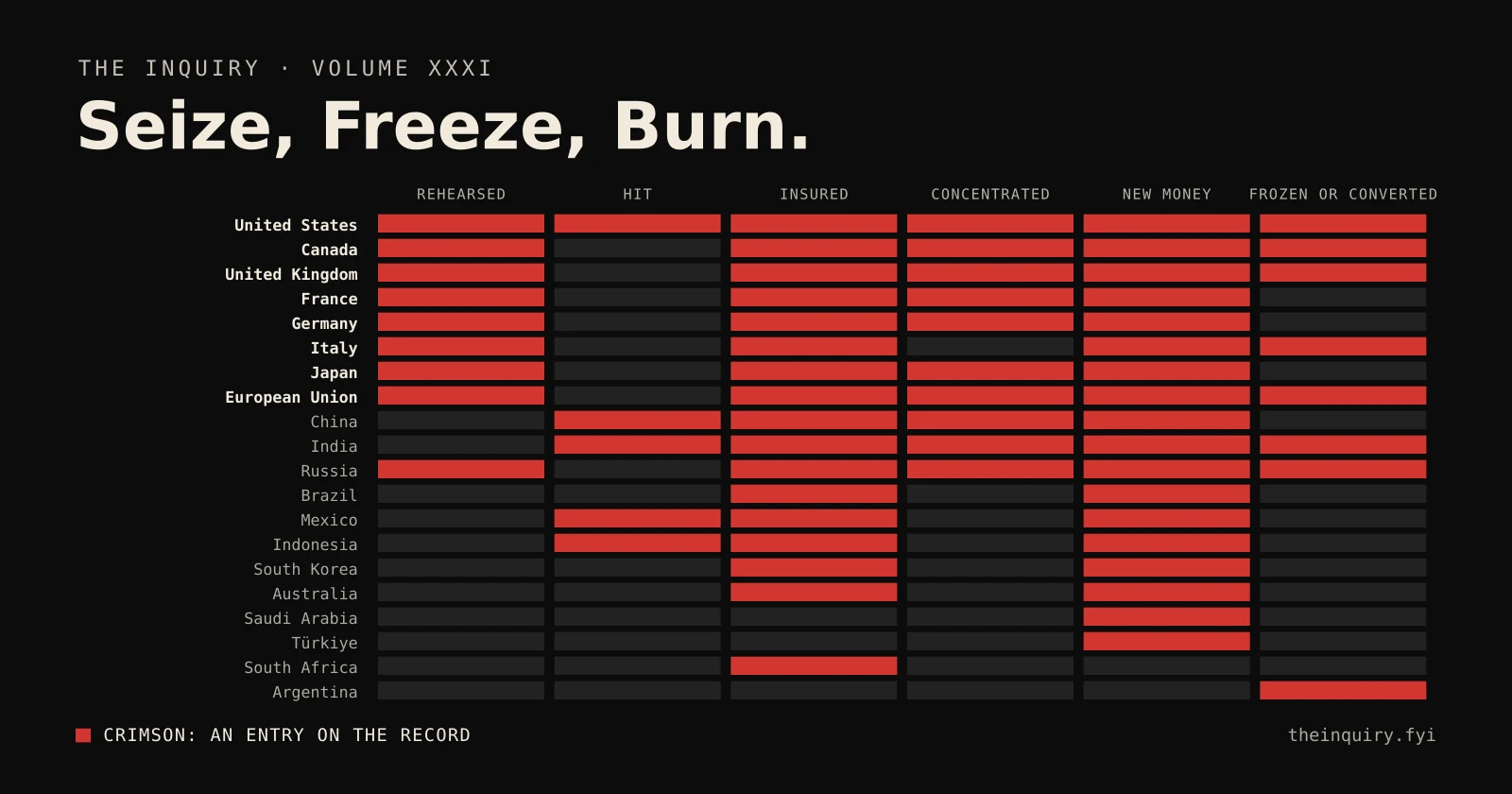
Every G20 member and the European Union, against the six pieces of this volume. Pick a column and each member shows what the record holds for it. An empty row is a member where we found nothing on the record, not a member that is clear of it.
Returned,
in another form.
Balances have been handed back in a different form before, by decision. In Cyprus in 2013, the Eurogroup ordered the Bank of Cyprus recapitalized “through a deposit/equity conversion of uninsured deposits”; by 30 July 47.5 per cent of those deposits had become shares. In Argentina, a decree of 2001 capped withdrawals at 250 pesos a week, and a decree of February 2002 converted dollar deposits into pesos at 1.40 to the dollar. In 2019 the central bank capped dollar purchases at US$200 a month; the cap for individuals was lifted in April 2025. In India, on 8 November 2016, notes making up 86.9 per cent of the currency in circulation by value stopped being legal tender overnight.
Freezes by order have their record too. On 15 February 2022 Canada’s Emergency Economic Measures Order told banks to stop dealing in any property of designated persons; officials told a Commons committee about $7.8 million had been frozen. The Federal Court found the invocation unreasonable in January 2024, and the Federal Court of Appeal dismissed the government’s appeal on 16 January 2026, holding that the searches the order authorized were unreasonable under the Charter. The Supreme Court of Canada agreed to hear the case on 22 October 2026. The G7 has immobilized Russia’s central bank reserves and lends against them: about $50 billion in loans repaid from their proceeds, and a European Union loan of €90 billion for 2026 and 2027, with the assets to “remain immobilised.” In the euro area, banks in resolution can be bailed in for at least 8 per cent of their liabilities before public money is used; covered deposits are excluded, uninsured ones are not.
Four pieces,
one design.
The record holds four pieces, and they are the same across the members. The destruction of a bank’s ledger is rehearsed by central banks, supervisors, police and private firms, from Washington to Frankfurt to Tokyo to Moscow. The insurance a depositor relies on pays for a failure and says plainly it does not pay for theft. The banks that would carry the system through such an event are fewer and larger each year, and 21 of the 29 that matter globally sit in the G7. And the money now being legislated beside the deposit is built from the start to be seized, frozen, burned or stopped on order, by laws in Washington, Hong Kong, Tokyo, Brussels and Ottawa.
What connects them is the ledger. A balance is a line in a bank’s record; the restore decides what that line said. A token is a line in a record that also holds every address it has passed through, and the issuer must be able to act on any of them. That is where this volume meets LifeLog, which follows the same record from the side of a life.
Rehearsed: “the election was cancelled.”
Insured: against failure, “not against losses due to theft or fraud.”
Restored: in money that must be able to be seized, frozen and burned.
Where to check
every line above.
The rehearsals
- Cybereason, Operation Blackout wrap-up report, Washington, 5 November 2019; Quartz, 2019; LevelBlue acquires Cybereason, 25 November 2025; GovInfoSecurity, on SoftBank and Liberty Strategic Capital holdings.
- G7 cross-border cyber exercise, Banque de France, June 2019; François Villeroy de Galhau, May 2019.
- Cyber Polygon 2020 and 2021, reporting of Klaus Schwab’s remarks; Japan FSA, Delta Wall VII, December 2022; ECB, cyber resilience stress test, 26 July 2024.
- On USA Today’s “killware” interview with Alejandro Mayorkas, October 2021; CyberScoop, on Oldsmar, 2023.
The hits
- US Justice Department, Bangladesh Bank case, 6 September 2018; Expansión, the SPEI case according to the Banco de México, May 2018; BankInfoSecurity, Cosmos Bank, August 2018.
- Bank Syariah Indonesia, May 2023; ICBC Financial Services, November 2023; Evolve Bank & Trust, notice of data breach, 2024; IMF, Global Financial Stability Report, April 2024, ch. 3.
The cover and the survivors
- FDIC fact sheet, 28 July 2022; Regulation E, 12 CFR 1005.6; CDIC, what’s covered; PRA, £120,000 from 1 December 2025; Korea FSC, 22 July 2025.
- FS-ISAC, Sheltered Harbor; ABA Banking Journal, 14 May 2019; Grant Thornton, 2024; CDIC Data and System Requirements By-law.
- FDIC Quarterly Banking Profile, number of institutions, 1984–2026; FDIC, First Republic, 1 May 2023; Government of India, 30 August 2019; The Moscow Times, 22 July 2024; IMF, Canada, 2025; ECB, bank offices in the euro area; FSB, 2025 list of G-SIBs, 27 November 2025.
- Deposit insurers’ published limits, for the instrument: EU Directive 2014/49/EU; DICJ; Australia FCS; DICGC; Russia DIA; FGC; IPAB; LPS; CODI; China, Deposit Insurance Regulations, 2015.
The new money and its conditions
- GENIUS Act, S. 1582, enrolled text; HKMA, AML guideline for stablecoin issuers; Japan, Cabinet Office Ordinance No. 48 of 2023, art. 30; EU, Regulation 2023/1114 (MiCA), art. 94; Canada, Stablecoin Act, s. 72.
- Circle, USDC terms, §13; Tether, terms of service; AMLBot, stablecoin freezes 2023–2025; The Block, 23 April 2026.
- Reserve Bank of India, 8 February 2024; Shenzhen Luohu digital yuan red packets, October 2020; Central Bank of the Republic of Türkiye, November 2025; Bank of Russia, 31 August 2026; Banco Central do Brasil, Resolution 521; ECB, 30 October 2025; Christine Lagarde, 2 July 2026; Bank of England and HM Treasury, January 2024; Bank of England, systemic stablecoins, 22 June 2026; BIS, Project Agorá, 3 April 2024; BIS, Saudi Central Bank joins mBridge, 5 June 2024; Bank Indonesia, digital rupiah; Reserve Bank of Australia, tokenised money; Herald, Bank of Korea deposit-token test, 17 March 2026; EU, Regulation 2024/1624, art. 80; Bank of Italy, 22 November 2015; ECB, on Greece’s capital controls; UK, SI 2025/688.
The precedents
- Central Bank of Cyprus, 30 March 2013; Bank of Cyprus, 30 July 2013; Argentina, Decree 214/2002; BCRA, Communication A 8226, 11 April 2025; Reserve Bank of India, 10 March 2017.
- Emergency Economic Measures Order, SOR/2022-22; Global News, 22 February 2022; Federal Court of Appeal, 2026 FCA 6, 16 January 2026; CP24, 22 October 2026.
- G7 leaders, ERA loans, 25 October 2024; European Council, 18 December 2025; Bank Recovery and Resolution Directive, art. 44.
Visual direction after the oceanographic films of Jacques-Yves Cousteau and the crew of the R.V. Calypso, 1943–1996. The saucer is the SP-350 “Denise”. No affiliation; the debt is the point.