Without
Consent.
David Eby was British Columbia’s Attorney General when RCMP tactical units went through the Wet’suwet’en gates three times for a gas pipeline the hereditary chiefs had refused. He became Premier without a single member’s ballot, after his campaign’s complaint removed the rival who had signed up more new members than he had. He approved an LNG terminal over the written refusal of three First Nations, set out to cut back the Indigenous rights law he had voted for once the courts gave it force, and called an election two years early. On 24 October 2026 the voters answered: twenty-eight seats, down from forty-seven, the lowest turnout the province has recorded, and his resignation as leader the same night. Five charges. All five hold.
Five counts,
one sentence.
“David Eby’s legacy = human rights violating military raid on Wet’suwet’en as AG, cheating in the leadership race to become Premier, simping for LNG, colossally failing to uphold DRIPA, worst snap election in Canadian history.”
It went up a few hours after the polls closed, and it is a charge sheet: five counts, each one a plain English sentence anyone in the province could repeat. That is what makes it worth testing. A loose charge falls apart when it is held against the documents. These five do not. Every one of them stands on a court ruling, a government release, a party report, a United Nations decision or an election return, and the dates line up.
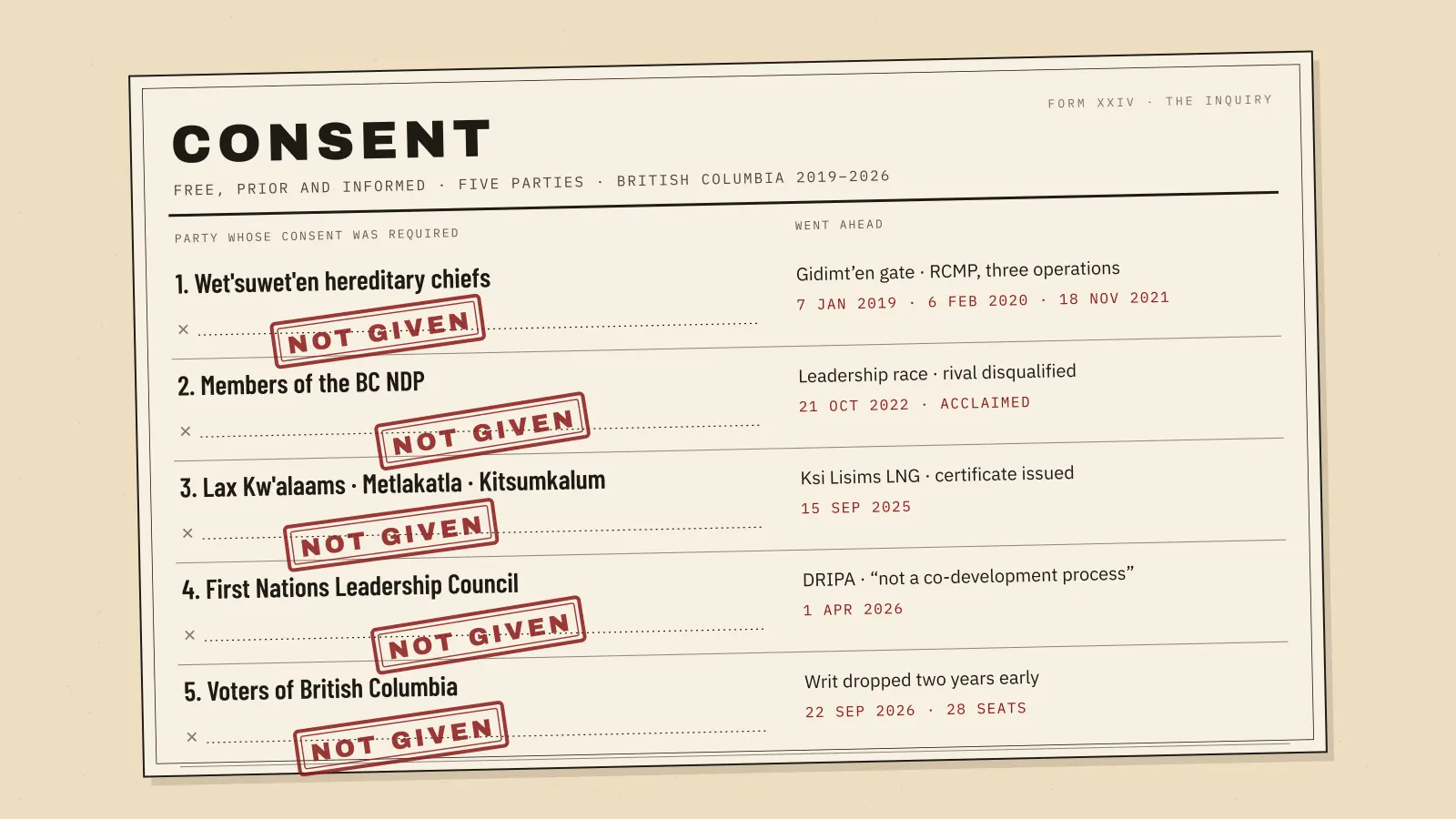
They also share a shape, which is the reason this volume treats them as one file rather than five complaints. In every count, someone’s consent was required: by the United Nations declaration British Columbia wrote into its own law, by a party’s rules for choosing its leader, by the province’s environmental assessment law, by the Declaration Act’s promise of co-development, and by the fixed election date. Each time it was asked for, or should have been. Each time the answer was no. Each time the work went ahead.
The crew’s way of putting it: a consent form with five lines, every line unsigned, every line stamped, and beside each one the date the thing was done anyway. The form is drawn above. The record behind each line follows, in the order it was made.
The record,
dated.
Twenty-three entries, each fixed by a document. The hinge rows are the ones where a refusal was on the record and the work went ahead.
Five counts.
Five hold.
Each count, in the post’s own words, against the file above. The sections that follow take them one at a time.
- “Human rights violating military raid on Wet’suwet’en as AG.” Three armed operations by a paramilitary police unit, in January 2019, February 2020 and November 2021, every one of them while Eby was Attorney General. A United Nations treaty body told Canada to withdraw the RCMP and stop the pipeline until the Wet’suwet’en consented. A B.C. judge found the officers’ conduct breached Charter rights.
- “Cheating in the leadership race to become Premier.” His campaign complained, his only rival was disqualified, and he took the job with no members’ vote. The rule used against her, responsibility for a third party’s membership drive, was not applied to the union drive that told its members to elect him. The election regulator found nothing against the third party she was removed over.
- “Simping for LNG.” Two terminals certified, one of them over the stated refusal of three Nations; the power line for the north coast moved out of environmental assessment; the climate test for LNG relaxed; and the Premier on the record calling LNG the reason B.C. will be Canada’s economic engine.
- “Colossally failing to uphold DRIPA.” When the Court of Appeal ruled that the Act he voted for meant what it said, he called it unlimited liability, drafted its weakening, proposed suspending it as a confidence vote, took the ruling to the Supreme Court, and campaigned against the decisions that enforced it.
- “Worst snap election in Canadian history.” A majority government called an election two years early, during the opposition’s leadership vacancy, and lost government: forty-seven seats to twenty-eight, the lowest turnout in the province’s record, the leader resigning on the night, and power handed to a party pledged to repeal the Declaration Act outright.
The gate:
three operations, one Attorney General.
The Royal Canadian Mounted Police began as the North-West Mounted Police, created by Parliament in May 1873 on the model of the Royal Irish Constabulary and organized along the lines of a cavalry regiment, with carbines and small artillery. It was an armed force for holding territory before it was a police service, and it still carries military-style ranks. In British Columbia it is also the provincial police, under contract with the province.
In 2017, the year Eby became Attorney General, the RCMP’s B.C. division created the Community-Industry Response Group, the C-IRG, “to provide a coordinated response to public order events related to large-scale resource-based industrial projects in British Columbia.” It had no fixed territory and no published budget. Records obtained by CBC put its spending on industry injunctions at close to fifty million dollars in its first five years. This is the unit that went through the Wet’suwet’en gates.
The hereditary chiefs had not consented to Coastal GasLink crossing their territory, and the checkpoints were the refusal in physical form. What answered it, three times, was the C-IRG: fatigues and rifles in January 2019, with planning notes calling for lethal overwatch, the term for snipers; dogs, tactical teams and helicopters in February 2020; assault rifles, an axe and a chainsaw at a cabin door in November 2021. The United Nations committee on racial discrimination asked Canada in December 2019 to halt the pipeline until the Wet’suwet’en gave free, prior and informed consent and to withdraw the RCMP. In April 2022 it wrote again to say things had got worse.
Military raid is the plain description of what happened. As AG is the plain description of when. The government Eby served in said in January 2020 that it could not direct the RCMP; its Solicitor General had, a week later, signed the letter authorizing the redeployment. The Attorney General’s own ministry houses the prosecution service that charged nineteen people after the third operation. People sat in his constituency office and asked him to intervene. There is no public record that he ever said a word against any of the three.
The courts have since caught up with part of it. In February 2025 Justice Tammen heard recordings of officers laughing about the women they had arrested and comparing them to orcs, and found the remarks “grossly offensive, racist, and dehumanizing” and a breach of their Charter rights, possibly a sign of “a systemic attitudinal issue within the C-IRG.” The federal police complaints commission received more than five hundred complaints and opened a systemic investigation of the unit in March 2023. Its report was finished by March 2026. Its release was postponed until after this election.
The ballot:
a leadership won by removing the opponent.
John Horgan announced his retirement in June 2022. The New Democrats set a members’ vote for 13 November to 2 December. Two candidates were in the race: Eby, the cabinet’s choice, and Anjali Appadurai, a climate organizer whose campaign brought in, by the figures reported at the time, around ten thousand new members to Eby’s six thousand, in a party that had about eleven thousand before the drive. The party declined to confirm the totals.
On 15 September Eby’s campaign filed a formal complaint. The party’s chief electoral officer, Elizabeth Cull, investigated Appadurai’s campaign over its links to Dogwood and 350.org and recommended disqualification for “improper co-ordination with third parties.” On 19 October the provincial executive agreed. On 21 October Eby was declared leader, unopposed. The members’ vote was cancelled because there was nobody left to vote against.
Two things make the word cheating the right one. First, the standard. A United Steelworkers local had told its members to join the party and elect David Eby to “push back on the green agenda,” after three meetings with his campaign in five weeks. Cull cleared that drive. Appadurai’s summary of the difference: “We were expected to take responsibility for the actions of third parties.” Eby was not. Second, the regulator. Elections BC, the body that actually enforces the province’s election finance law, closed its review of Dogwood the day after the disqualification without any finding of a breach.
A month before the ruling, an unnamed party source told The Breach the party was “eager for Appadurai to submit her application so she can be dismissed on a technicality.” One new member put the outcome in a sentence: “I didn’t sign up to be a member to fund David Eby’s coronation.” He was sworn in as Premier on 18 November 2022 without a single member’s ballot cast for him.
The terminal:
LNG first, and said out loud.
Simping means devotion that asks nothing back. The record of Eby’s premiership on liquefied natural gas fits it.
Four months in, in March 2023, his government certified Cedar LNG on the same day it released an energy framework built around it. In January 2025 he announced that the North Coast Transmission Line, four hundred and fifty kilometres of power line from Prince George to Terrace to electrify northern LNG, would be permitted by the Energy Regulator instead of going through environmental assessment, on the grounds that the regulator had “a history of showing success at getting projects moving quickly.” Its estimated cost later doubled to about six billion dollars, carried by ratepayers. In 2025 the province relaxed its test for new LNG from net zero by 2030 to net zero ready, and offered a two-year break from the industrial carbon tax. The Canadian Centre for Policy Alternatives summed it up: “The provincial priority is LNG development, first and foremost.”
Then Ksi Lisims. On 15 September 2025 the province certified a floating terminal for twelve million tonnes a year near the Alaska border. The environmental assessment law Eby’s government operates asks participating Nations whether they consent. Lax Kw’alaams, Metlakatla and Kitsumkalum said no. The ministers’ release conceded that “not all concerns were resolved,” and issued the certificate. Two months later the federal government fast-tracked the terminal, its pipeline and the power line together, and Eby welcomed it: “British Columbia is going to be the economic engine of this new economy.” Lax Kw’alaams and Metlakatla went to court.
In July 2025, celebrating the first cargoes out of Kitimat, he said it in one line: “Projects like LNG Canada are the reason that B.C. will be the economic engine of a more independent Canada.”
The Declaration:
voted for, then fought once it worked.
In November 2019 the legislature passed the Declaration on the Rights of Indigenous Peoples Act unanimously. Eby voted for it. Section 3 says the government, in consultation and cooperation with Indigenous peoples, must take all measures necessary to make the province’s laws consistent with the United Nations declaration. For four years it was treated as a promise. Then the Gitxaala Nation went to court over the mineral claim system, which let claims be staked on their territory online without consulting them, and on 5 December 2025 the Court of Appeal ruled that the Act meant what it said: the declaration has immediate legal effect in British Columbia, and the claim system is inconsistent with it.
The Premier’s answer was to call the ruling “unlimited legal liability” and set about weakening the law. In January 2026 he said it would be revised to scale back the courts’ role. A leaked draft in March replaced consistent with the declaration with “working toward aligning enactments with the declaration.” On 1 April: “Yes, we are going to get these amendments through.” And, on how they were drafted: “This has not been a co-development process.” Days later he proposed suspending parts of the Act for up to three years and making the vote a matter of confidence. The First Nations Leadership Council called it “a unilateral betrayal.” On 20 April, with his caucus divided, it was dropped for the spring.
It was not dropped. The province took Gitxaala to the Supreme Court of Canada, which agreed in May to hear it. In August 2025 the B.C. Supreme Court had found Cowichan title over part of Richmond, and the province had appealed that too. On the campaign trail in September 2026 Eby called the two rulings “dramatic, overreaching and unhelpful court decisions” and said responding to them was “not up for debate.” The law requires the government to make its laws consistent with the declaration in cooperation with Indigenous peoples. When a court ordered exactly that, the government he led went to the country’s highest court to get out of it.
The other side of this count is in Volume XVI: the same government’s plan to move land returns under the Forest Act, with a feedback deadline that fell three days after the writ.
The writ:
two years early, and the answer.
British Columbia has a fixed election date. Section 23 of the Constitution Act puts the vote on the third Saturday in October, four years after the last one. The last one was 19 October 2024, when the New Democrats won forty-seven of ninety-three seats, a majority of one. The next was due on 21 October 2028. In December 2025 Eby said: “We’re not seeking an election here.”
On 20 September 2026 the Conservative leader, Kerry-Lynne Findlay, resigned after defections. Two days later Eby asked for a dissolution, citing an “existential moment” and Donald Trump. Kirk LaPointe in The Hub: “Nothing about the Trump threat changed in the two days since Kerry-Lynne Findlay resigned.” The call cancelled a by-election set for four days later. It overlapped the municipal vote of 17 October. It put the federal police watchdog’s report on the C-IRG, and every unanswered question about the Declaration Act, on the far side of polling day.
On 24 October the province answered. In the initial count the Conservatives won sixty-three seats with 48.1 percent of the vote, the New Democrats twenty-eight with 37.4, the Greens two. The New Democrats received more than two hundred and seventy thousand fewer votes than two years earlier. Preliminary turnout was 48.06 percent, below even the pandemic election of 2020, the lowest the province has recorded. Eby held Vancouver–Point Grey by 538 votes and resigned as party leader in his concession speech. The political scientist Stewart Prest: “This is Mr. Eby’s low-turnout election to own, and this is going to be part of his legacy.”
Canada’s best-known early-election disaster until now was Ontario’s in 1990, when David Peterson called a vote three years into a majority and lost it. This one goes further on every count that is about the call itself: two years into a mandate rather than three, timed to an opponent’s vacancy rather than a high in the polls, and ending in a record low turnout and a government with a stated plan to repeal the Declaration Act, double LNG output by 2032 and scrap the industrial carbon tax. The final count begins on 6 November. Return Day is 18 November.
The register:
who was asked, what they said, what went ahead.
One line per count. Each line names the rule that required consent, the answer that was given, and the date the work went ahead regardless.
The legacy,
as the record writes it.
The post called it a legacy, and the word is exact. A legacy is what is left when someone goes, and Eby went on the night of 24 October. What he left is a pattern rather than a list. A province that wrote free, prior and informed consent into its own law spent the next seven years treating consent as the step to get past: at a gate on Wet’suwet’en territory, in a party’s membership rolls, in an environmental certificate, in the law itself once a court enforced it, and in the date voters were promised.
None of that is hidden. Every line above is in a court file, a government release, a party report or an election return, and the sources follow. What is still to come is the record that was held back: the police watchdog’s report on the C-IRG, finished in March and released, by its own schedule, only once the votes were in; the final count, beginning 6 November; and the Supreme Court’s ruling on whether British Columbia’s Declaration Act means what the legislature, Eby included, voted that it meant.
Five lines on the form, and a place for a signature on each.
The chiefs said no at the gate, the members never got a ballot, three Nations wrote no, the Council wrote betrayal.
The voters signed the last line themselves, on 24 October, and wrote no on it too.
Where to check
every line above.
Grouped by the count each one supports.
iv. The gate
The operations, the notes, the United Nations, the court
- Coastal GasLink Pipeline Ltd. v. Huson, 2019 BCSC 2264, 31 December 2019, and Coastal GasLink, update on the Morice River bridge crossing, 18 December 2018: the injunctions.
- Jen St. Denis, “RCMP planned snipers at Wet’suwet’en pipeline protest”, The Tyee, 20 December 2019, relaying The Guardian’s report of the same day on the RCMP planning notes; and the RCMP’s response as reported by the Georgia Straight.
- Committee on the Elimination of Racial Discrimination, Decision 1 (100), Early Warning and Urgent Action procedure, 13 December 2019; the third letter of 29 April 2022 as reported by APTN.
- Union of B.C. Indian Chiefs, release of the Solicitor General’s letter of 27 January 2020, 6 March 2020, with Premier Horgan’s statement of 20 January.
- Georgia Straight and CityNews, January 2020: the occupation of the Attorney General’s constituency office.
- Global News and CBC, February 2020: the second operation and its arrests; Ricochet on the helicopter landings.
- CBC, on the November 2021 operation and the trial testimony; Peace Brigades International Canada, 15 October 2026; The Narwhal on Amber Bracken’s arrest and lawsuit.
- The Energy Mix and CBC, 18 February 2025: Justice Tammen’s ruling.
- The Canadian Encyclopedia, “Royal Canadian Mounted Police”: the 1873 founding and the cavalry model. Civilian Review and Complaints Commission, launch of the systemic investigation of the C-IRG; CBC on its spending.
- Peace Brigades International Canada, 19 March 2026 and 25 October 2026; APTN, 24 September 2026: the report completed and held past the election.
v. The ballot
The complaint, the report, the regulator
- The Tyee, 19 October 2022 and 20 October 2022: the chief electoral officer’s report and the complaints from Eby’s campaign.
- The Maple: the 15 September complaint and the members’ objections.
- The Tyee, 25 October 2022: the Steelworkers memo and its clearance.
- Elections BC, “Review into possible political contributions closed”, 20 October 2022.
- The Breach, 23 September 2022: membership figures and the party source. Global News, 21 October 2022: the acclamation.
vi. The terminal
The certificates, the line, the Premier’s words
- Government of B.C., Cedar LNG certificate and energy framework, 14 March 2023.
- The Narwhal, January 2025, and on the line’s cost.
- Marc Lee, “Painting itself into a corner”, Canadian Centre for Policy Alternatives, 14 May 2025.
- Government of B.C., “Premier celebrates first LNG Canada shipments to Asia”, 30 July 2025.
- Government of B.C., Ksi Lisims LNG certificate decision, 15 September 2025; The Narwhal on the federal referral of 13 November 2025 and the court challenges.
vii. The Declaration
The Act, the rulings, the rollback
- Gitxaala v. British Columbia, 2025 BCCA 430, 5 December 2025, as summarized by Osler and OKT; Cowichan Tribes, 2025 BCSC 1490, as reported by CFJC.
- CBC, January 2026: the announced revision.
- Journal of Commerce / The Canadian Press, April 2026: the leaked draft and the 1 April statements.
- The Narwhal, 6 May 2026: the suspension proposal and the Leadership Council’s letter; Daily Hive, 20 April 2026: the joint statement.
- CTV News, 21 May 2026: leave to appeal. The Narwhal, 7 October 2026: the campaign statements.
viii. The writ
The fixed date, the call, the count
- Constitution Act, RSBC 1996, c. 66, s. 23.
- Elections BC, 2026 Provincial General Election: writ, voting day, final count and Return Day.
- Global News, 22 September 2026: the call; Kirk LaPointe, “Nobody but David Eby wants this B.C. election”, The Hub, 22 September 2026.
- BC Ballot, initial count complete 26 October 2026; The Hub and CTV News on the result and the resignation.
- Global News and CBC: turnout. The Narwhal: the incoming government’s pledges.
Visual direction after the oceanographic films of Jacques-Yves Cousteau and the crew of the R.V. Calypso, 1943–1996. The saucer is the SP-350 “Denise”. No affiliation; the debt is the point.