Supported
By.
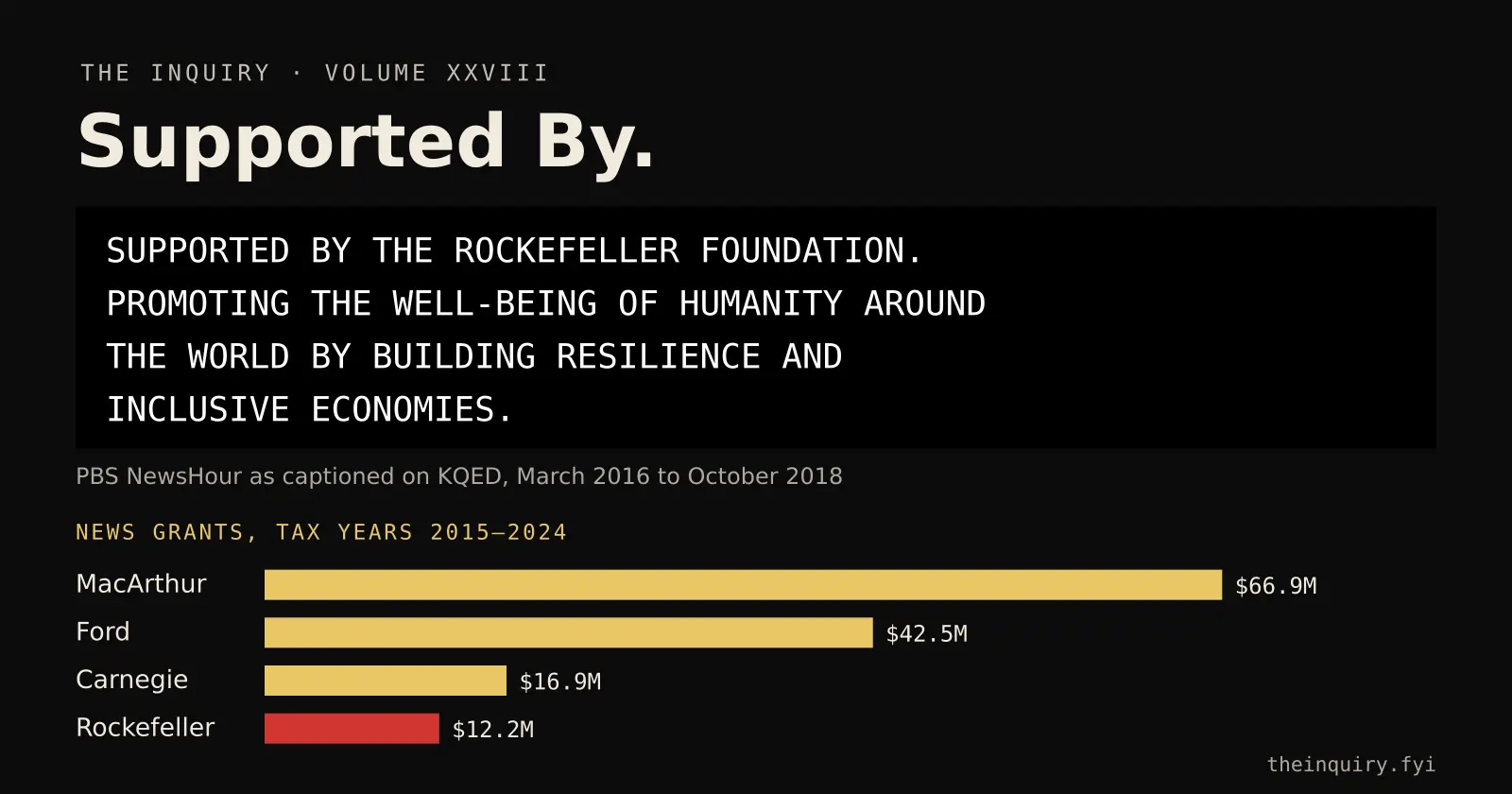
From March 2016 to October 2018, PBS NewsHour carried a line before the news: “Supported by the Rockefeller Foundation. Promoting the well-being of humanity around the world by building resilience and inclusive economies.” The Foundation’s tax filings show what it paid for, in its own words. Four foundations put at least $138 million into American news in nine filing years. None of it was earmarked to examine them.
Read on the air,
night after night.
The Internet Archive keeps the closed captions of KQED, a PBS station in San Francisco. Searching them for the Foundation’s name turns up the credit first on 14 March 2016 and last on 9 October 2018. In the archive’s sample it appears 17 to 28 times a month until April 2017, then under a dozen times a month. Nearly every caption comes from PBS NewsHour.
A funding credit is the visible end of a grant. This volume reads the other end: what the money was given for, as the foundations declared it to the Internal Revenue Service. The claim is narrow. These funders do not need to censor anything. A subject they pay for arrives with their name on it, and the name certifies it.
The record,
dated.
Twelve entries. The hinge rows are the ones where a grant names the subject or the audience.
Four boards,
the same newsrooms.
For tax years 2015 to 2024 the Internal Revenue Service publishes these foundations’ returns as data; the 2019 returns are missing for all four. Matching the recipients to news organizations gives at least $138.4 million: MacArthur $66.9 million, Ford $42.5 million, Carnegie $16.9 million and Rockefeller $12.2 million. In the same returns the four paid out about $10.6 billion in all, so news is a small share of their giving and a large share of some newsrooms’ outside money.
The overlap is the point. All four funded WETA, the station behind PBS NewsHour: $20.9 million in those years. All four funded NPR, $12.3 million, and GBH, the Boston station that makes Frontline and NOVA, $11.8 million. The same four boards appear again behind ProPublica, the Center for Public Integrity and The Atlantic. These figures come from matching names in the returns, so they are a floor.
Money given
for a subject.
A return lists every grant with a line for its purpose. Most of Ford’s news money carries a general-support label. Almost none of Rockefeller’s does: about 5 percent. The rest names a subject, and the subject is usually the Foundation’s own program.
“For use by its PBS NewsHour in support of broadcast and web reporting focused on sudden shocks and what it takes to recover from them as a more cohesive, resilient community.”Rockefeller Foundation to WETA, $350,000 in 2015 and $150,000 in 2016
New York Public Radio received $400,000 from 2015 to 2017 for resilience programming and for “providing ongoing training to other public radio stations on how to report stories with a resilience framework.” The Guardian received at least $4.8 million from 2014 to 2018 for a Cities section “to foster reader engagement and understanding of resilience.” The New York Times Company received $200,000 in 2018 for a conference “to raise awareness of opportunity zones.” A 2010 grant paid for Marketplace segments on impact investing “to educate the public about the opportunities for social benefit and financial return.”
The practice is not Rockefeller’s alone. MacArthur paid The Atlantic $900,000 in 2023 “to increase public awareness of the problem of jail overuse.” Ford paid $1 million in 2015 for Marketplace’s Wealth and Poverty Desk. MacArthur gave the PBS Foundation $50,000 in 2016 for productions “focused on selected MacArthur Fellows.” Carnegie gave GBH $351,000 in 2024 for educational materials on nuclear security.
Blueprint America:
$4.5 million.
The largest single block is a PBS series. In 2008 the Foundation gave the parent of Thirteen/WNET in New York $2,035,000 “to increase awareness of American infrastructure and climate change issues.” In 2009 it gave $1,750,000 “in support of ‘Blueprint America,’ a public broadcasting effort,” and in 2010 $750,000 for a broadcasting effort on transportation and community. The series’ own page on PBS says that major support “is provided by the Rockefeller Foundation.”
In the same years the Foundation paid WNYC $1.55 million for coverage of transportation and infrastructure policy. Here the grant line states the aim plainly: awareness, which means public attention to a subject the funder had chosen.
Pick a newsroom,
see who paid.
Every grant of $25,000 or more matched to a news organization: the four foundations from 2015 to 2024, and Rockefeller back to 2000. Purposes are quoted as filed, in English.
The slogan rose.
The reporting did not.
If a grant moves coverage, its subject should rise on air once the money arrives. The archive measures how often a word is spoken, as a share of each station’s airtime. On KQED, “resilience” went from 0.027 percent in 2015 to 0.086 percent in 2016. CNN, Fox News and MSNBC stayed flat, and on KQED so did “empathy,” “sustainability” and “community.”
Then the credit is subtracted. The Foundation’s name accounts for 0.059 percent in 2016 and 0.049 percent in 2017, which is nearly all of the jump. What is left is 0.027, 0.030 and 0.031 percent, the 2015 level. On this measure the program’s own use of the word did not change. The funder’s slogan did. The test is crude: one word, one station’s whole schedule. A handful of funded segments would not move it. It is the result, and it stays on the page.
449 grants,
none aimed home.
These funders pay for accountability reporting on prisons, police, money in politics and corporations. Of the 449 news grants in the returns, four mention philanthropy, foundations or donors at all. One is an event for public media staff, one is a station’s community work, one is general support for Mother Jones, and one is MacArthur’s grant for productions about MacArthur Fellows. None pays anyone to examine foundations.
General support can pay for any story, and purpose lines are short. But the record shows money earmarked for many subjects and none earmarked for this one. The funded press examines nearly every powerful institution except the one paying it.
1956 and 2016:
the same instrument.
In 1956 the Foundation paid for the Academy’s radiation study, its officer chaired the genetics panel, and its own annual report says copies went to every public library in the United States. The publisher of the New York Times sat on its board. Sixty years later its name was read before the evening news. Neither case shows the funder writing the story. Both show the funder choosing the question and lending it standing. That is certification, and it leaves no censor to find.
They do not own the story.
They choose which ones get told.
Foundations are a minority of public media’s money, and these four are not the only ones. What the returns show is narrower and harder to dismiss. A few unelected boards fund the same newsrooms. They pay for named subjects with stated aims of awareness and understanding. Their slogans are read on the air. And none of their news money is set aside to look at them.
The one test available found the reporting unmoved. A slogan read before the news does not need to move it. The money buys a subject a place on the agenda and buys the funder a place beside the news. A press without other funders would have to take the gift on those terms.
$138 million, four boards, nine filing years.
One credit, read on the air for two and a half years.
449 grants, none to examine the funders.
Where to check
every line above.
The returns
- Rockefeller Foundation, EIN 13-1659629, Form 990-PF, 2000–2024: index of returns; 2010 return; 2023 return. Figures before 2015 come from the returns’ text, with 2014 checked against the page image.
- IRS e-file index and returns, tax years 2015–2024, for Ford (13-1684331), Carnegie Corporation (13-1628151), MacArthur (23-7093598) and Rockefeller: IRS index. Not available: 2019 for all four, Carnegie’s fiscal 2015 and 2020, part of Ford’s 2024. MacArthur’s 2021 total did not parse.
The credit and the test
- GDELT Project, television API over the Internet Archive’s TV News captions: KQED, CNN, Fox News and MSNBC, share of airtime by year.
- PBS, Blueprint America: funding.
Visual direction after the oceanographic films of Jacques-Yves Cousteau and the crew of the R.V. Calypso, 1943–1996. The saucer is the SP-350 “Denise”. No affiliation; the debt is the point.